Blog

Study of the Religious Landscape on Twitter

A recent study looks at the U.S. religious landscape on Twitter. The researchers analyzed nearly 100 million tweets across 250,000 Twitter accounts to identify similarities and differences among self-identified followers of Christianity, Atheism, Judaism, Islam, Buddhism, and Hinduism. Christians comprise the largest number of accounts, at just over 200,000, and I’ll focus on them here.

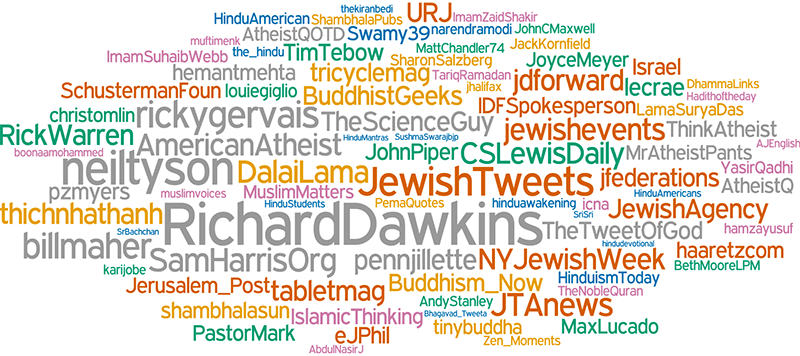
A word cloud shows the most-relevant accounts to follow for each religion.

This word cloud shows the accounts that adherents to each religion are more likely to follow than people of other religions. Green is Christian, gray is atheist, orange is Jewish, pink is Muslim, yellow is Buddhist, and blue is Hindu. This figure is reproduced from the original paper.

According to the paper, here are the most-popular Twitter accounts that Christians tend to follow more than followers of other religions:

  1. RickWarren
  2. CSLewisDaily
  3. TimTebow
  4. JohnPiper
  5. PastorMark
  6. lecrae
  7. JoyceMeyer
  8. MaxLucado
  9. christomlin
  10. louiegiglio
  11. MattChandler74
  12. JohnCMaxwell
  13. AndyStanley
  14. BethMooreLPM
  15. karijobe

(I’m estimating from the above word cloud, so the exact order may be off.)

And, again according to the paper, here are the words that Christians most-commonly use in tweets compared to followers of other religions–in other words, these words serve as statistical markers of Christianity: if you use them a lot, you’re probably a Christian or hang out with Christians.

  1. Jesus
  2. Christ
  3. God
  4. Church
  5. Lord
  6. Christian
  7. Bible
  8. Prayer
  9. Pray
  10. Worship
  11. Grace
  12. Blessed
  13. Faith
  14. Praise
  15. Pastor

(Again, I’m eyeballing the order from the word cloud included in the paper.)

Most-popular Christian leaders on Twitter?

In March 2014, I wondered if it would be possible to identify and cluster the most-popular “Christian” Twitter accounts. Starting with a list of 100 Christian leaders on Twitter, I wrote a program to work through their friend lists (and then the friends of those friends, and so on), seeing who Christian leaders most tended to follow. After crunching the numbers for 13,316 users, I took the top 200 (using a PageRank algorithm) you see below.

The list contains 149 men, 23 women (by my count, all but nine–Christine Caine, Joyce Meyer, Bobbie Houston, Beth Moore, Lysa TerKeurst, Jen Hatmaker, Ann Voskamp, Sheila Walsh, and Anne Lamott–are artists or wives of prominent Christian men; the remainder are speakers or writers), 22 organizations, and 6 quote accounts (two for C.S. Lewis and one each for Tim Keller, A.W. Tozer, Charles Spurgeon, and Henri Nouwen).

Originally I wanted to cluster them (pastors, artists, etc.), but the math didn’t produce strong clusters except to identify the spam accounts (most of them spouting random Bible verses).

Here are the top 200 “Christian Twitterati” in March 2014, along with their descriptions as they appeared at that time.

RankAccountNameTypeDescription (March 2014)
1.RickWarrenRick WarrenmaleNo socks. Loves Jesus & people.Mentors young leaders. Helps the poor, sick & lost thru P.E.A.C.E. Plan. Serves Saddleback. Encourages pastors. Wrote some books
2.louiegiglioLouie GigliomaleHappy to be a door holder.
3.MattChandler74Matt ChandlermaleGrace addict, husband to @laurenchandler, father of three, Lead Pastor @villagechurchtx, President @Acts29 Church Planting Network
4.joelhoustonJoel Timothy HoustonmaleGracious fury, written in my saviours scars; Mercy Mercy, now engraved upon my heart. ZION - 26 • 2 • 13
5.shelleygiglioshelley gigliofemalepart of the 268generation...
6.lecraeLecraemaleBooking: Mike infocmg@wmeentertainment.com Larry larryshields@theagencygroup.com
7.timkellernycTimothy KellermaleThis is Timothy Keller. Sometimes my son and others post here as well. Founder of Redeemer Presbyterian Church and City to City. Husband to Kathy.
8.BrianCHoustonBrian HoustonmaleMy wife and I are pastors and founders of a church called Hillsong. We are pretty passionate about our family, the Church, & helping people any way we can!
9.DarleneZschechDarlene ZschechfemaleMarried 2 Mark, Mum 2 Amy& Andrew, Chloe & Zoe, Grammie 2 Ava Pearl, Roman Emmanuel & Ruthie Feather,committed 2 serving Christ & worshipping Him with all I am.
10.christynockelsChristy NockelsfemaleWife! Mother, singer, poet, songwriter
11.ChristineCaineChristine CainefemaleFollower of Jesus Christ.
12.CTmagazineChristianity TodayorganizationChristianity Today is the source for those eager to engage the world for Christ and curious about the people, events, and trends shaping the church and culture.
13.CSLewisDailyC. S. LewisquotesC. S. Lewis Quotes - Everyday
14.christomlinChris Tomlinmalehusband, father, songwriter
15.MaxLucadoMax Lucadomalei played tuba in the High School marching band. been trying to stay in step with the music ever since.
16.drmooreRussell MooremalePresident, Ethics & Religious Liberty Commission
17.PastorMarkMark DriscollmaleA nobody trying to tell everybody about Somebody.
18.edstetzerEd StetzermaleChristian, hubby, #DadOf3Girls, pres of @LifeWayResearch, missiologist, @GoGraceChurch pastor. Too loud. Fast talker. Sry I can't read/reply to all msgs & DMs.
19.passion268Passion ConferencesorganizationA student movement inspiring a generation to live for what matters most. [Isa. 26:8]
20.bradlomenickBrad Lomenickmaleleading the charge on CATALYST (@CatalystLeader), a movement of young leaders
21.craiggroeschelCraig GroeschelmaleHusband, Dad, Pastor of LifeChurch.tv
22.mattmahermusicMatt Mahermalenewfoundland to phoenix to nashville to ________
23.AndyStanleyAndyStanleymaleDo more. Give more. Be Rich.
24.crowdermusicDavid Crowdermale
25.matt_redmanMatt RedmanmaleHusband, Father, Songwriter
26.israelhoughtonisraelhoughtonmaleHusband, Father, Friend of God.
27.bubbawatsonbubba watsonmaleChristian. Husband. Daddy. Pro Golfer. Check out BubbaGolf on iTunes! #bubbagolf #urwelcome
28.judahsmithJudah SmithmaleLead Pastor at @thecitychurch, husband, father, and golfer. http://t.co/2xyMToSx6q
29.BillHybelsBill HybelsmaleSr. Pastor of Willow Creek, convener of The Global Leadership Summit, passionate about the local church, author, speaker, sailor, and grandfather to Henry & Mac
30.reuben_morganReuben Morganmalewriter+believer. thankful to be here now on a mission with people I love
31.JohnPiperJohn PipermaleFounder-Teacher, Desiring God, Chancellor, BCS. Spreading a passion for the supremacy of God in all things for the joy of all peoples through Jesus Christ.
32.carllentzNYCcarl lentzmaleHILLSONGNYC..if you don't know, now you know...
33.JoyceMeyerJoyce MeyerfemaleSharing Christ – Loving People
34.jdgreearJ.D. GreearmaleLead Pastor of the Summit Church. Husband to Veronica, dad of Kharis, Allie, Ryah and Adon. Author of 'Gospel.' Not 'the' gospel, but a book about it. Rom 1:16.
35.kpstanfillKristian Stanfillmale#Passion2014 // Atlanta Jan 17-18 // Houston Feb 14-15 // two cities...one heartbeat.
36.bobbiehoustonBobbie HoustonfemaleWife of Brian, mum of Joel/Esther/Ben/Luc/Laura/Pete, Grammie of Sav, Lexi,Bailey, Willow,Jack,ZIon. Grateful follower of Christ!
37.stevenfurtickSteven FurtickmalePastor of Elevation Church. New book - CRASH THE CHATTERBOX - now available
38.donaldmillerDonald MillermaleFounder of StoryBrand, a process that helps companies speak clearly to their customers. Husband to @queenboots.
39.JentezenJentezen Franklinmale
40.DailyKellerTim Keller WisdomquotesFan Promo Site for Tim Keller @timkellernyc. Tweeting all things Keller and Gospel related - Books, Quotes, News, Blogs, Updates, and Kindle Deals Daily.
41.LisaBevereLisa BeverefemaleA woman w/a weapon who wants to be sure every girl has a sword. Author-Advocate & Speaker. Wife of John Bevere-mother of 4 sons-Gmama of 2+.
42.BethMooreLPMBeth MoorefemaleCrazy about Jesus. Saved my life. Want to see people know Him and love Him.
43.nickygumbelNicky GumbelmaleHusband of @pippagumbel, Vicar of @htbchurch & pioneer of @alphacourse. Pippa & I write a daily Bible commentary http://t.co/y7xmCjzhta #BiOY #Alpha #TryAlpha
44.davidnasserDavid NassermaleHusband,father, author, speaker, pastor...
45.darrinpatrickDarrin PatrickmaleSon, Husband, Father, Pastor, Chaplain to the St Louis Cardinals - Author of The Dude's Guide to Manhood
46.TGCThe Gospel CoalitionorganizationTGC exists to promote gospel-centered ministry for the next generation.
47.LigonDuncanLigon DuncanmaleChancellor/CEO of the Reformed Theological Seminary system @ReformTheoSem and John E. Richards Professor of Systematic and Historical Theology
48.JohnCMaxwellJohn C MaxwellmaleBestselling author & speaker on leadership. Christian. Blogger. Trainer. Coach. Assisted by Stephanie Wetzel (SW).
49.DaveRamseyDave RamseymaleNew York Times best-selling author and host of The Dave Ramsey Show. Follow the rest of my team at @RamseyShow, @DaveRamseyLIVE, and @EntreLeadership
50.michaelwsmithMichael W. SmithmaleNew single YOU WON'T LET GO now available EVERYWHERE! From the new Michael W. Smith album, SOVEREIGN available everywhere May 13, 2014!
51.HarrisJoshJoshua HarrismalePastor @Covenantlife. In love with Shannon. Three awesome kids. Learning to be a disciple of Jesus day by day. Written some books.
52.TimTebowTim TebowmaleBlessed
53.TripLee116Trip LeemaleRapper, Author. Living by faith in a good God. The Good Life Album and Book are in stores now
54.Chris_HodgesChris HodgesmaleFollower of Jesus, husband, dad, senior pastor of Church of the Highlands, author of Fresh Air.
55.rayortlundRay Ortlundmale
56.greglaurieGreg LauriemalePastor and Evangelist :: Knowing God and Making Him Known :: Maintained by Pastor Greg and the Harvest Web Team
57.perrynoblePerry NoblemaleSenior Pastor of @NewSpring. Author of Unleash! and Overwhelmed.
58.EdYoungEd YoungmaleI'm Ed Young, husband, father of four and the senior pastor of Fellowship Church, located in Dallas/Ft. Worth, TX; Miami, FL; Columbia, SC; and London, England.
59.PaulTrippPaul David TrippmalePastor. Author. Conference Speaker. Connecting the transforming power of Jesus Christ to everyday life.
60.MarkBattersonMark BattersonmaleLead Pastor, National Community Church in Washington DC. Author, The Circle Maker, All In, In a Pit with a Lion on a Snowy Day, Wild Goose Chase, Soulprint...
61.hillsongunitedHillsong UnitedorganizationWhite Album avalaible for pre purchase - http://t.co/tOkODeCkb7
62.karijobeKari JobefemaleWorshipper. Girly-girl. Longboard skateboard-er. World traveller. Random tweeter. Songwriter. I love life and Jesus. MAJESTIC CD/DVD will release March 25!
63.BishopJakesTD JakesmaleOfficial Twitter for Bishop T. D. Jakes
64.albertmohleralbertmohlermalePresident @sbts; author; broadcaster; theologian
65.TozerAWA W TozerquotesInspiring, encouraging and challenging quotes from the new works of AW Tozer--including My Daily Pursuit--and a few of his classic quotes.
66.CSLewisUC. S. LewisquotesDaily Thoughts and ideas from CS Lewis
67.JudWilhiteJud WilhitemaleSenior Pastor at @centralonline. Married to @Lori_Wilhite with 2 kids. New York Times Best-Selling author. Espresso addict & Dallas Cowboys fan.
68.PriscillaShirerPriscilla ShirerfemaleJust a girl....with a Sword
69.jamesmacdonaldJames MacDonaldmaleRevelation 1:2 - For the Word of God and the testimony of Jesus Christ
70.ScottyWardSmithScotty SmithmaleFounding Pastor of Christ Community Church. Husband, dad, granddad, lover of the gospel, photographer, fisherman, and so blessed
71.dinorizzoDino RizzomaleHusband to DeLynn, father to three awesome kids, and author of the book Servolution.
72.plattdavidDavid PlattmaleHusband to Heather. Dad to Caleb, Joshua, Mara Ruth, & Isaiah. Pastor of The Church at Brook Hills.
73.JosephPrinceJoseph PrincemaleIt’s my passion to share God’s grace radically & see lives gloriously transformed!
74.between2worldsBetweenTwoWorldsmaleJustin Taylor: Christian, husband, father, elder, acquisitions editor, blogger
75.desiringgodDesiring GodorganizationWe want people everywhere to understand and embrace the truth that *God is most glorified in us when we are most satisfied in him*
76.MarkDeverMark Devermale
77.CJMahaneyC.J. MahaneymaleProne to wander, Lord, I feel it, Prone to leave the God I love; Here's my heart, O take and seal it, Seal it for Thy courts above.
78.RevKevDeYoungKevin DeYoungmaleSenior Pastor, University Reformed Church. Married to Trisha. Five children. Christian.
79.ThabitiAnyabwilThabiti AnyabwilemaleForeknown, predestined, called, justified, glorified. Hubby to Kristie, daddy to 3, Pastor of FBC, satisfied in Christ.
80.GabeLyonsGabe Lyonsmale
81.JeffersonBethkeJefferson BethkemaleI like to drink coffee, create stuff, & sleep. Husband to @alyssajoybethke & Co-Founder of @clarocandles. Author of this -- http://t.co/wLOFZhkjh1
82.jackngrahamJack GrahammaleHusband to Deb. Dad to Jason, Kelly, Josh. Dad in love 2 Toby, Kaytie. Grandad to Ian, Dylan, Levi. Pastor Prestonwood.
83.bobgoffBob GoffmaleAuthor of Love Does. President and Founder, Restore International
84.CatalystLeaderCatalystorganizationA Convergence of Next Generation Leaders
85.KayWarren1Kay WarrenfemaleMom of 3,Grammy of 5, pastor's wife, speaker, author,& advocate for those living with HIV, mental illness & 4 orphans. Determined 2 say yes to God, 2 choose joy
86.TonyDungyTony DungymaleHusband to @LaurenDungy, father of nine, author (http://t.co/mOupp6iBLw), retired NFL coach, National Spokesman for @AllProDad. Live by Mark 8:36
87.mandisaofficialMandisafemaleJesus-follower. Contemporary Christian recording artist. Author. American Idol Season 5 finalist. Picture of health wrapped in a not-so-perfect tent...for now!
88.macpowellMac PowellmaleLead Singer of Third Day. Solo Country Project now available!
89.JohnBevereJohn BeveremaleHusband of Lisa. Father to Addison & Juli, Austin, Alec, & Arden + G-Daddy to Asher & Baby Sophia! Author & Ambassador of Jesus Christ.
90.pwilsonPete WilsonmalePastor of @crosspoint_tv in Nashville, author of #LetHopeIn, husband, and father of 3 boys.
91.richwilkersonjrRich Wilkerson Jr.maleMarried to the greatest lady in the world. Young adult pastor of The Vous (http://t.co/P23VgE2sqM)
92.laurenchandlerLauren Chandlerfemalewife to matt. mother to audrey, reid + norah. lover of God. singer of songs. writer of stuff.
93.AndyMineoAndy Mineomale-|| Artist | Unashamed | #116 | Never Land EP & Heroes For Sale out now! ||- Booking (WME): http://t.co/0B2UdfwgWx
94.Spurgeon_Charles Spurgeonquotes
95.theResurgenceResurgenceorganizationResurgence serves the church on mission by creating tools, training believers & connecting leaders. Sign up for our Resurgence conference http://t.co/A8kt1gsbwW
96.RealJohnGrayJohn GraymaleAventer's husband. John IV and Theory's dad. Alice's son. God's Servant. Associate Teaching Pastor, Lakewood Church.
97.stovallweemsStovall Weemsmale
98.drtonyevansTony EvansmaleServing my Savior and my King. #KingdomMan #KingdomAgenda
99.JustinHolcombJustin HolcombmaleEpiscopal priest, professor, & author
100.MatthewBarnettMatthew BarnettmalePastor of The Dream Center & Angelus Temple. Pre-order my new book “God’s Dream For You” -http://t.co/tCqS3DA2wT - Follow me on Instagram http://t.co/8SovoK95h3
101.TheA21CampaignThe A21 CampaignorganizationWe abolish human trafficking in the 21st century.
102.kevingeraldKevin GeraldmaleLeader, wife-lover, Jesus follower. http://t.co/sYxprXXCKS
103.randyalcornRandy AlcornmaleAuthor of over forty books, founder of Eternal Perspective Ministries; love Jesus, my wife Nanci, daughters, sons and five grandsons!
104.collinhansenCollin HansenmaleEditorial Director for The Gospel Coalition, Author of 'A God-Sized Vision' and 'Young, Restless, Reformed'
105.jonathanfalwellJonathan FalwellmalePastor of Thomas Road Baptist Church in Lynchburg, VA.
106.RealEricGeigerEric GeigermaleVice President LifeWay Christian Resources. I follow Jesus and serve His Church, love my wife and kids, and want to play more basketball.
107.enditmovement❌ END ITorganizationShine A Light on Slavery.
108.kirkfranklinKirk FranklinmaleThe Official Kirk Franklin
109.NatalieGrantNatalie GrantfemaleJesus girl. Family girl. Singer girl. Freedom fighter.
110.PastorTullianTullian TchividjianmalePastor of @coralridgepc. Founder of @liberatenet. Grandson of @BillyGraham. Learning everyday that Jesus + Nothing = Everything.
111.PhilCookePhil CookemaleHelping churches & nonprofits not suck at the media. http://t.co/EDnq7j8qXD http://t.co/Z4XZwHOgMk Recent books: One Big Thing & Unique
112.RaviZachariasRavi ZachariasmaleFounder & President of Ravi Zacharias International Ministries. Atlanta | Worldwide. Helping Thinkers Believe & Believers Think. Staff assists with tweets.
113.LysaTerKeurstLysa TerKeurstfemaleI've had a crush on Art for 20 years. We love 5 kids like crazy. I adore my team at Proverbs31ministries. I wrote Made to Crave, Unglued, and a few others.
114.PsRobertMorrisRobert MorrismaleOfficial Twitter for Robert Morris, Senior Pastor of @GatewayPeople, and the author of The Blessed Life and The Blessed Church. http://t.co/WsY79Qngh8
115.israelnewbreedisraelnewbreedorganization
116.caseytreatCasey TreatmaleSenior Pastor @CFCSeattle, husband, father, friend, & author. Romans 12:2 changed my life & can change yours too.
117.rick_bezetRick BezetmaleHusband to Michelle, Dad to Hunter/Hailee/Tanner/Grace! Pastor to New Life Church in AR! My dog hates me.
118.JenHatmakerJenHatmakerfemaleWife, mama of 5 (3 the old fashioned way...2 from Ethiopia), writer, speaker, foodie, Wii Just Dance Champion, gardener, hash tag abuser, Jesus girl.
119.JLin7Jeremy Linmaleto know Him is to want to know Him more
120.BillyGrahamBilly GrahammaleOfficial Twitter page of Rev. Billy Graham. Account is run by @BGEA staff.
121.joechampionJoe ChampionmaleLove Jesus, Love my family, Love my Church.
122.PastorSergioSergio De La MoramalePastor of the Cornerstone Church of San Diego, Father, Husband, Visionary, Author of The Heart Revolution.
123.realrobbellRob Bellmale
124.hillsongliveHillsong LIVEorganizationThe Official Hillsong LIVE Twitter. Our latest live album #GloriousRuins is now available! http://t.co/8M8uQwehgs
125.JoelOsteenJoel OsteenmaleDaily inspiration to help you live the life of victory and abundance that God intended for you. http://t.co/6apEukVPbT
126._Matt_CarterMatt CartermaleLover of Jesus. Husband of an amazing woman. Father to 3 delightful children. Pastor of Preaching @ The Austin Stone. Author of The Real Win w/ Colt McCoy
127.MichaelHyattMichael HyattmaleAuthor of the New York Times bestseller, Platform: Get Noticed in a Noisy World. Founder of http://t.co/UNZmxcFox9. Forbes Top 50 Social Media Influencer 2013
128.LeeStrobelLee StrobelmaleFollower of Jesus. Husband, dad, grandfather. Author of 20+ books, including The Case for Christ & The Case for Faith. Professor at Houston Baptist University
129.bennyperezBenny PerezmaleHusband, Father, Lead Pastor of The Church LV. Join us for @DedicatedLV in Vegas June 25th-27th. Register at http://t.co/z89UxZQAkd
130.TroyGramlingTroy GramlingmaleHusband, Father of 3, Lead #Pastor at @PotentialChurch.
131.PontifexPope FrancismaleWelcome to the official Twitter page of His Holiness Pope Francis
132.RealRomaDowneyRoma DowneyfemaleRoma actress and producer of emmy nominated series The Bible seen by over 100 million people in USA and Son of God to be released Feb 28th 2014
133.bobbygwaldBobby GruenewaldmalePastor, Innovation Leader @ LifeChurch.tv. a founder @ http://t.co/QDlDdOyo. Passionate about my family, The Church, Leadership, Mobile Technology.
134.DarrenWhiteheadDarren WhiteheadmaleHusband to Brandy. Dad to Sydney, Scarlett & Violet. Aussie. Author of Rumors of God.
135.AnnVoskampAnn VoskampfemaleWife to the Farmer: Mama to 6 : Author of NYTimes Bestsellers: One Thousand Gifts ... & ... The Greatest Gift. Seeking to follow One alone.
136.IJMIntl Justice MissionorganizationOfficial International Justice Mission twitter securing rescue for victims of slavery & other violent forms of oppression. Tweeters: Austin/Tierney/Jaclyn
137.RevRunWisdomRev RunmaleWords of wisdom non-stop.. Pls don't be offended if I don't reply or follow u, But I Love you!
138.DannyAkinDaniel Akinmale
139.ahcAndy CrouchmaleWriter (Playing God, Culture Making) | Executive Editor (@CTmagazine) | Producer (@ct_city) | Dad
140.hillsongHillsong ChurchorganizationHillsong Church is all about loving God and people.
141.PastorChrisHillChris HillmaleOfficial Twitter for Pastor Chris Hill. Son, husband, father, friend, mentor, preacher & Senior Pastor of The Potter's House Church of Denver.
142.JonAcuffJon AcuffmaleNew York Times Bestselling Author of Start/Speaker. Married to Jenny. Dad to L.E. and McRae.
143.ronniefloydRonnie FloydmaleSenior Pastor of @CrossChurch, a multi campus faith family, the founder of @CCSchoolofMin. Passionate about preparing leaders for global Gospel advancement.
144.johnnymhuntJohnny HuntmalePastor of FBC Woodstock since Dec. 1986. FORMER President of the Southern Baptist Convention
145.SheilaWalshSheilaWalshfemaleBorn in Scotland, now a US citizen, wife, mom of 1 boy and 3 pups. Overwhelmed by the fiery love and mercy of God, found it impossible to keep it to myself
146.CrosswayCrosswayorganizationCrossway is a not-for-profit publisher of Christian books, the ESV Bible, and gospel tracts. Tweets by @angelacheatham and @jameskinnard [at the time tweeted as @CrosswayBooks]
147.bilcorneliusBil CorneliusmaleLeader/founding pastor/speaker/author/entrepreneur I love Jesus, @jesicacornelius,my 3 kids, @bafchurch, & people.I could eat Mexican food 5 days a week.
148.9MarksOnline9Marksorganization9Marks exists to equip church leaders with a biblical vision and practical resources for displaying God's glory to the nations through healthy churches.
149.RichWilkersonRich WilkersonmalePastor @TrinityMiami husband of 1 wife Robyn 4 sons 2 daughters 1 GrandDarling... Love God & Love Ppl
150.KerryShookKerry ShookmaleSenior pastor of @WoodlandsChurch. Husband to the beautiful @ChristineShook. Dad to Ryan, Josh, Megan & Steven. NY Times Bestselling author.
151.gregsurrattGreg SurrattmalePastor - Seacoast Church
152.TommyTenneyTommy TenneymaleHappy husband to the ever amazing @JeannieTenney • Father to 3 delightful daughters • Blessed with 4 grandchildren • Son of @TFTenney • Christ follower • Cajun
153.scotmcknightscotmcknight maleProfessor @nseminary
154.DrHenryCloudDr. Henry CloudmalePsychologist, Author, and Leadership Consultant. http://t.co/haDxnxImhX
155.mattfryMatt FrymaleLead Pastor C3 Church http://t.co/Pr8QOnjHgq ARC Lead Team http://t.co/wtA6HwBOFi
156.pastoremaseEric MasonmaleJesus follower, Husband of @ImmNehe, Father, Pastor @epiphfellowship Author of #ManhoodRestored
157.bibleseriesThe Bible' SeriesorganizationThe Bible' is an epic journey from Genesis through Revelation produced by Roma Downey & Mark Burnett. Emmy nominated & seen by 100 million people & counting!
158.tommybarnettTommy BarnettmaleSenior Pastor, Phoenix First Assembly in Phoenix (http://t.co/jUYIccxdTd), Arizona; co-founder of the LA Dream Center and NY Dream Center
159.ericmetaxasEric Metaxasmaleis the author of BONHOEFFER: Pastor, Martyr, Prophet, Spy and AMAZING GRACE: William Wilberforce & the Heroic Campaign to End Slavery.
160.FirstLadyJakesSerita JakesfemaleOfficial Twitter for First Lady Serita Jakes
161.erwinmcmanusErwin McManusmaletraveling the universe with my band of outsiders in search of beauty, wonder, and a good story.
162.johnortbergJohn OrtbergmaleAuthor Speaker Pastor
163.Fred_BuechnerFrederick BuechnermaleChristian theologian and author of 36 books, including fiction, autobiography, essays, sermons, quotes, and other nonfiction.
164.hillsongNYCHillsong NYCorganizationThe best way to stay in touch with what's happening in Hillsong NYC! Also, check out - http://t.co/3WbMj7pyX8 and http://t.co/X7ytKmHdiE
165.jrvassarJR VassarmaleChrist follower, Husband, Father, Pastor.
166.ANNELAMOTTANNE LAMOTTfemaleAuthor - Bird by Bird, Traveling Mercies, Some Assembly Required, Help Thanks Wow. Mom, Nana, activist; elder at St. Andrew Prez--services at 11:00.
167.RedeemerNYCRedeemer Pres NYCorganization
168.RichStearnsRich StearnsmalePresident of World Vision USA, and author of The Hole in Our Gospel and Unfinished: Believing Is Only the Beginning (April, 2013)
169.ihoughtonIsrael HoughtonmaleHusband, Father,Friend of God
170.LarryOsborneLarry OsbornemalePastor, Author - North Coast Church, Vista CA Blog:http://t.co/cybdjDrxo6
171.PastorChrisSeayChris SeaymalePastor of Ecclesia Houston, President of Ecclesia Bible Society/Translator of The Voice ( a beautiful and faithful translation of scriptures), Husband and Dad
172.charitywatercharity: waterorganizationWe're an NYC-based charity working in 20 developing countries around the world, bringing clean water to people in need.
173.Michael_CardMichael CardmaleChristian Author, Singer/ Songwriter. Written 23 books and 30 albums Well known and loved through songs like El Shaddai, Immanuel and Come Lift Up Your Sorrows
174.CharlesJenkins7Charles JenkinsmaleI laugh I serve I create I give
175.dancathyDan T. CathymaleCEO and President of Chick-fil-A, but I like to say I'm in Customer Service
176.kimwalkersmithKim Walker-SmithfemaleI love Jesus, Skyler (my knight-in-shining-armor), Wyatt (my wildly handsome son), Duke & Stella (my cuddly dogs), and chocolate. In that order.
177.RELEVANTRELEVANT MagazineorganizationThe leading magazine on faith, culture & intentional living. Covering what's relevant to your life—in print, iPad & daily online. (Founded by @CameronStrang.)
178.tonymorganliveTony MorganmaleI help leaders and organizations get unstuck.
179.therealtobymacTobyMacmaleI got my eye on it!!
180.Clayton_kingClayton KingmaleFounder & President of Crossroads Ministries, Teaching Pastor @ Newspring Church, Campus Pastor @ Liberty University, Author for Lifeway & Baker Pub
181.JeanneMayoJeanne MayofemaleWife + Mom + Nana + Coach + Author + Speaker + Cadre + Atlanta Leadership College + 212 Director = Love to Meet You!! #follow #StuMin @YLCoach
182.jaredcwilsonjaredcwilsonmaleHusband, father, pastor, author. My latest book STORYTELLING GOD available now from Crossway.
183.JonTysonJon TysonmaleTrinity Grace Church : City Collective : City Renewal. Planting in Midtown Manhattan. Pursuing the way of Jesus : Joining God in the renewal of all things.
184.brandonheathBrandon HeathmaleDon't miss Brandon on #HitsDeepTour and check out his album Blue Mountain on iTunes http://t.co/WnmvSIeP3E
185.jamiemunsonJamie MunsonmaleCoPresident of @Storyville Coffee, Writer at http://t.co/IDic6PFedy, Author of 2 Books - Authority and Money
186.BurkParsonsBurk ParsonsmaleI'm not my own but belong to Jesus Christ whom I trust, follow, and preach as an ordinary pastor, dad, and husband making disciples of nations for God's glory.
187.philwickhamPhil WickhammaleThe Ascension now available on iTunes! http://t.co/fMqmAHW5bS
188.HenriNouwenHenri NouwenquotesHenri Nouwen - author, theologian, mentor, pastor, activist, Dutch priest, and above all - beloved.
189.MikeFosterMike FostermaleLover of imperfectionists. Founder of @POTSC. Author of Freeway: A Not-So-Perfect Guide To Freedom. I believe in love, God and you.
190.cameronstrangCameron StrangmaleFounder of @RELEVANT, daddy of Cohen, follower of Jesus, publisher, podcaster, fan of the Magic & Gators. But not in that order.
191.bloodwaterBlood:WaterorganizationPartnering with Africa to end the HIV/AIDS & water crises
192.jonforemanJon ForemanmaleI play music in bands called switchfoot, and fiction family. I am grateful to be alive.
193.JonathanMerrittJonathan MerrittmaleSenior Columnist, Religion News Service @RNS; Author of A Faith of Our Own (2012) and Jesus is Better Than You Imagined (2014)
194.loswhitCarlos WhittakermaleAuthor of Moment Maker :: Hater of Meatloaf :: Lover of Familia
195.DanKimball Dan Kimball maleon staff at Vintage Faith Church, author of They Like Jesus But Not The Church
196.stevekmccoySteve K. McCoymaleI've heard and I believe. I study and I preach. I imagine and I create. I am loved and I love.
197.challieschalliesmaleOwner and proprietor of http://t.co/UVIRyi9y.
198.lovedoesLove Doesorganization
199.williebosshogWillie RobertsonmalePresident of Duck and Buck Commander. Personality on both, Duck Dynasty and Buck Commander Protected by Under Armour.
200.coltondixonColton Dixonmalelove God. love music. love people

Via MIT Technology Review.

Posted in Twitter

Seasonal Interest in Bible Reading Plans

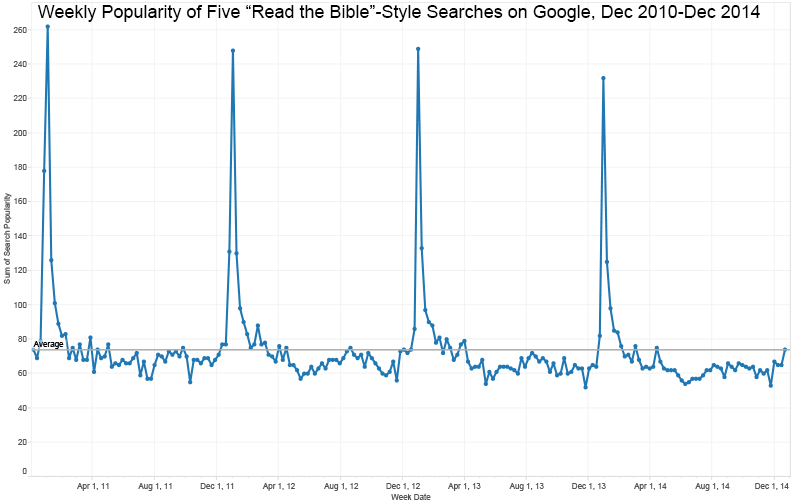
Just in case you wonder how seasonal people’s interest in reading the Bible is, here’s a chart from Google Trends showing five “read through the Bible”-related search terms. The peaks every January speak for themselves. You can see a secondary peak in August or September when classes get underway at many schools.

If we take some of the above data, plot it by week rather than by month, and add it together, the effect is even more vivid:

This chart shows peaks every January. (This chart goes through December 27, 2014.)
You see huge peaks just before and after January 1 each year, along with a small bump around Easter and the aforementioned mellow spike in August or September. The interest related to the new year is almost entirely gone by February. You could interpret this drop as “Everyone who’s interested has already found their reading plan for the year,” or you could interpret it as, “Well, Genesis was interesting. Maybe I’ll read through the Bible next year.”

Inspired by Google Trends of Popular New Year’s Resolutions.

Posted in Reading, Visualizations

The Bible on Twitter in 2014

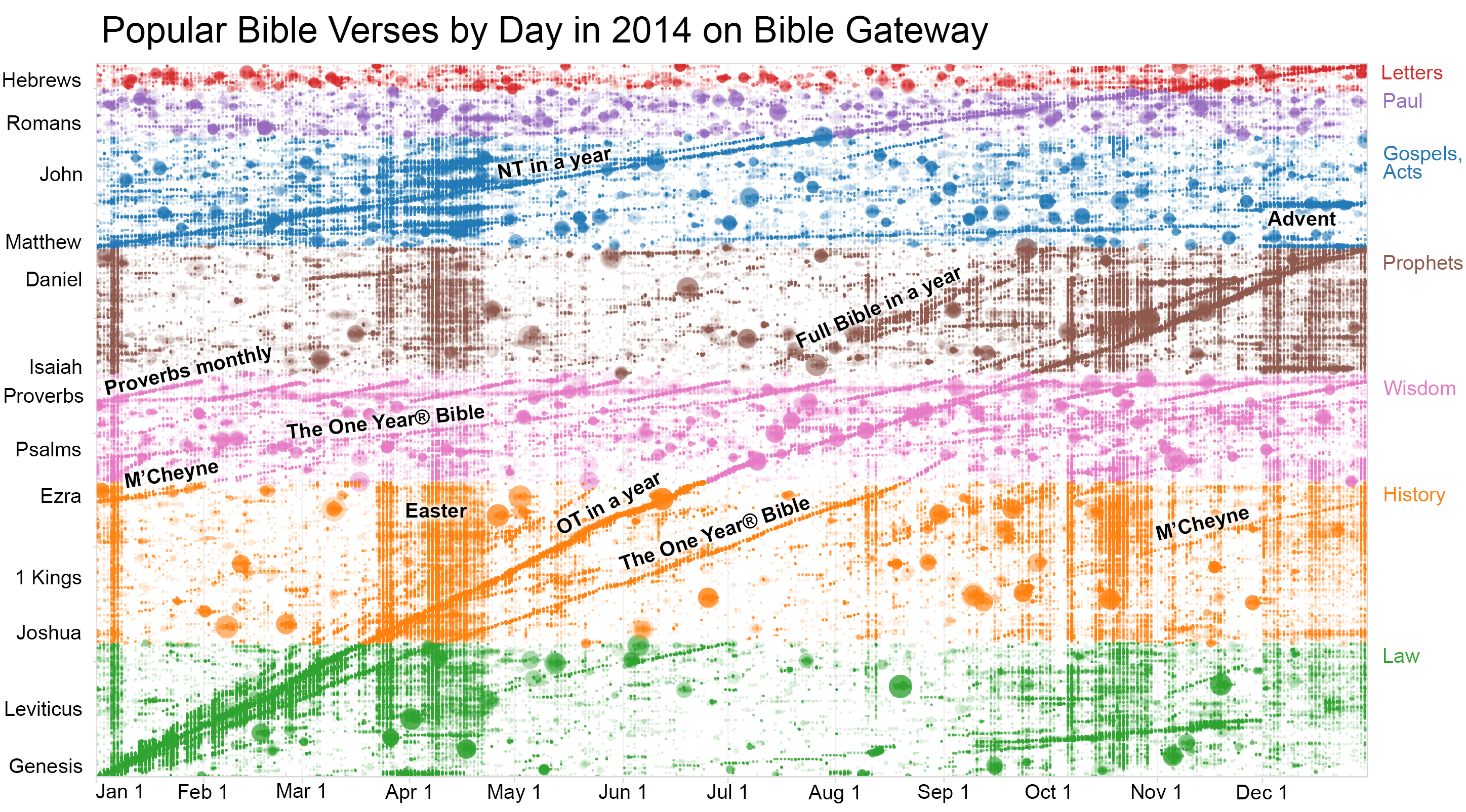
Bible Gateway recently shared their most-popular Bible verses of 2014, and I wanted to discuss this chart a little more:

Popular Bible verses by day in 2014 on Bible Gateway

The chart stems from the idea that if someone is equally likely to see a verse on any day of the year, each day should have 1/365, or 0.27%, of a verse’s yearly popularity. This chart shows days when there’s a spike in pageviews for each verse for a particular day (whenever it was over 0.4% of the annual total).

The theme of the chart is that people follow certain paths through the Bible during the year; I labeled a few of them on the chart. But there are definitely a few patterns I can’t explain:

  1. At the beginning of the year, two lines emanate from Genesis that look like they're on track to read the full Bible in a year, but one of them is faster than the other. Why are there two?
  2. At the bottom right of the chart is a shallow line that looks like it involves reading Genesis and Exodus starting in May and ending in December. There's a similar line in the New Testament running through Matthew from June to November. What are those?

I was curious whether the same patterns would appear in Twitter for the year, so I ran a similar analysis on the 43 million tweets this year that mentioned Bible verses. The answer is that, yes, you can see many of the same paths in both charts:

Popular Bible verses by day in 2014 on Twitter

They even include the same two (or three or four) fast readings of the Bible at the beginning of the year and the slow reading of Genesis and Exodus in the second half of the year. You can see similar peaks around the Passion stories leading to Easter and the Nativity story leading to Christmas. (Christmas is the last day that appears on this chart.) The Twitter chart more clearly shows the weekly rhythms of the devotional life, with vertical lines just barely visible every Sunday. The main difference is that there’s not as clear a path through the New Testament.

The Twitter chart also shows some horizontal bands where sharing is pretty light. These “sharing shadows” appear in the opening chapters of Numbers, 1 Kings, and 1 Chronicles.

Prolific Verse Sharers

A quirk of the Twitter chart is that some Twitterers tweet (and are retweeted) a lot. I suspect many of them are bots, but it’s hard to say whether they constitute “Bible spam”–many people do appear to find them helpful by retweeting them. The top fifty or so Twitterers are responsible for 16 million of the 43 million tweets this year. The chart doesn’t look too different if you remove them (mostly, the frequent repetition of Matthew disappears), but that just could be because I didn’t remove enough users to affect the results meaningfully. For all I know, this chart mostly just shows how Twitter bots share the Bible during the year. The consistency with the Bible Gateway data (in which I have more confidence), however, leads me to think that this picture is reasonably accurate.

Here are the top non-bot (as far as I can tell) sharers of Bible verses–these people tweeted the most Bible verses (and, more importantly, were retweeted most) throughout the year. Some of these people I recognize, and others… not so much. The “tweet” numbers reflect only tweets containing Bible verses and include others’ retweets of their tweets.

  1. JohnPiper (105,836 tweets)
  2. DangeRussWilson (87,382 tweets)
  3. WeLiftYourName (52,638 tweets)
  4. JosephPrince (50,889 tweets)
  5. BishopJakes (49,109 tweets)
  6. siwon407 (48,994 tweets)
  7. RickWarren (42,637 tweets)
  8. JoyceMeyer (39,703 tweets)
  9. jeremycamp (32,003 tweets)
  10. DaveRamsey (28,173 tweets)
  11. RCCGworldwide (26,731 tweets)
  12. AdamCappa (25,976 tweets)
  13. Creflo_Dollar (24,422 tweets)
  14. sadierob (20,068 tweets)
  15. Carson_Case (19,846 tweets)
  16. TimTebow (18,303 tweets)
  17. Kevinwoo91 (17,230 tweets)
  18. levimitchell (16,355 tweets)
  19. jesse_duplantis (15,755 tweets)
  20. kutless (14,806 tweets)

Most-Popular Verses

Here are the most-popular verses shared on Twitter in 2014:

  1. Phil 4:13 (613,161 tweets)
  2. 1Pet 5:7 (261,417 tweets)
  3. Prov 3:5 (218,019 tweets)
  4. John 14:6 (212,883 tweets)
  5. John 13:7 (207,084 tweets)
  6. 1Cor 13:4 (197,379 tweets)
  7. Matt 28:20 (187,407 tweets)
  8. Ps 118:24 (183,475 tweets)
  9. 2Tim 1:7 (182,758 tweets)
  10. Ps 56:3 (180,139 tweets)

You can also download a text file (411 KB) with the complete list of 2014’s popular verses.

John 13:7 (“Jesus replied, ‘You do not realize now what I am doing, but later you will understand.’”) is the oddball here, but it turns out that it’s mostly from over 100,000 retweets of a single tweet in April. (Since it was a one-off, I omitted him from the list of top sharers above, although his tweet count of 163,497 would put him in first place.)

How do the year’s most-popular verses compare among Bible Gateway, YouVersion, and Twitter? The answer: there’s a good deal of variation. Below are the top ten from each service; only Proverbs 3:5 appears in all three lists, and YouVersion and Twitter only have one verse that overlaps, which surprises me (given that they’re both based on sharing).

If we look only at Bible Gateway and Twitter, the average verse differs in its ranking by about 3,000 places, or nearly 10% of the Bible. The largest differences in rank: 1 Kings 20:14 is much more popular on Twitter (rank 4,380) than on Bible Gateway (rank 27,119), while Ezra 5:14 is way more popular on Bible Gateway (rank 13,995) than Twitter (rank 30,018).

RankingBible GatewayYouVersionTwitter
1.John 3:16Rom 12:2Phil 4:13
2.Jer 29:11Phil 4:81Pet 5:7
3.Phil 4:13Phil 4:6Prov 3:5
4.Rom 8:28Jer 29:11John 14:6
5.Ps 23:4Matt 6:33John 13:7
6.Phil 4:6Phil 4:71Cor 13:4
7.1Cor 13:4Prov 3:5Matt 28:20
8.Prov 3:5Isa 41:10Ps 118:24
9.1Cor 13:7Matt 6:342Tim 1:7
10.Rom 12:2Prov 3:6Ps 56:7
Bold entries appear in at least two lists.

Data Source

The Twitter data is from Bible Verses on Twitter. A program connects to the Twitter Streaming API with a query for every chapter of the Bible (“Gen 1”, “Genesis 1”, and so on). I run a Bible reference parser on the tweet to pull out all the references. Then an SVM algorithm tries to guess whether the tweet is actually talking about a Bible verse or just happens to contain a string that looks like a Bible reference (“Gen 1 XBox for sale,” where “Gen” is short for “Generation”).

Sidenote: How I Calculate Verse Views

A note on methodology: I’ve never documented how I determine a particular verse’s popularity; now’s a good time, because you can do it a number of ways to reach different answers. Let’s say that someone is looking at Genesis 1, which has 31 verses. That counts as one pageview, but if you’re looking for the number of pageviews that, say, Genesis 1:1 receives, how do attribute a chapter-length view like this? You could give each verse credit for a full pageview, but then verses in long chapters will appear to have a disproportionately high number of pageviews. Instead, I prefer to divide the pageview into the number of verses in the passage: in this case, each verse in Genesis 1 will receive 1/31, or 0.032 pageviews.

Now, what if someone is looking at, say, Genesis 1:1 and Matthew 1 (25 verses) on the same page? In this case, I divide the pageview by the number of separate passages: Genesis 1:1 receives credit for a full 0.5 pageviews, as does Matthew 1. Each verse in Matthew 1 therefore receives 0.5/25, or 0.02 pageviews.

I feel that this approach best respects people’s intentions whether they want to look at multiple verses, several independent passages, or just individual verses.

Posted in Bible, Twitter, Visualizations

What Twitterers Are Giving up for Lent (2014 Edition)

The top 100 things that people on Twitter are giving up for Lent in 2014.

This year, “School” topped the list of things Twitterers are giving up for Lent, up 44 places from last year. Remaining in the top ten from last year are Swearing, Alcohol, Soda, Social Networking, and Fast Food. Chocolate, Twitter, Sweets, and Lent round out the new additions to the top ten.

I don’t have a great explanation for why School is #1 this year–it could be that Ash Wednesday is later this year, so spring break is closer (for some it even starts today). It’s also possible that Twitter’s audience is skewing younger than it used to, or that younger Twitter users are more likely to tweet about Lent.

Timely topics this year are Boosie, referring to rapper Lil Boosie, who was released from prison this week (people joked that the prison was giving him up for Lent); and Electricity, referring to a widespread power outage in South Africa.

This list draws from 646,000 tweets during March 2 to 8 that mention giving up something for Lent and excludes retweets.

RankWordCountChange from last year’s rank
1.School11,757+44
2.Chocolate9,515+15
3.Twitter8,642+8
4.Swearing7,132-2
5.Alcohol6,3250
6.Soda5,446-3
7.Social networking4,197-3
8.Sweets4,188+8
9.Fast food4,0880
10.Lent2,842+118
11.Meat2,790+26
12.Homework2,760+61
13.Junk food2,723+8
14.Coffee2,678+123
15.Sex2,392+112
16.Chips2,129-10
17.Bread2,020+114
18.You2,016+21
19.Facebook1,9260
20.Pizza1,628+122
21.Starbucks1,566+120
22.Candy1,412+87
23.Instagram1,212-13
24.Religion1,147+104
25.Virginity1,143-18
26.Cookies1,053-14
27.Work1,031+4
28.Ice cream1,025+27
29.Boys1,021+99
30.Marijuana1,018-22
31.Smoking994-9
32.Beer939+104
33.Life933-8
34.Food930+27
35.McDonalds926+20
36.Winter853 
37.Netflix851-7
38.College819+16
39.My phone777+6
40.Shopping748+103
41.Stuff733+100
42.Selfies731+1
43.Chipotle726+100
44.Masturbation725-30
45.Sugar682+82
46.Cheese670+94
47.Me656+87
48.Sobriety655-17
49.Wine652+94
50.Carbs648+81
51.Boosie581 
52.Fried food574-23
53.Caffeine563+70
54.Rice562+86
55.Catholicism561-28
56.Snapchat543+11
57.Coke541-22
58.Procrastination517-18
59.People516+54
60.Snow506 
61.Desserts486-37
62.Fizzy drinks480+81
63.French fries475-29
64.Takeout464-49
65.Obama452+74
66.Makeup451-25
67.Taco Bell434+39
68.Feelings434-32
68.Porn430 
69.Nothing427+74
70.My swag420-47
71.Negativity417+28
72.Red meat396+59
73.Diet Coke390+69
74.Sarcasm380 
75.Breathing369 
76.Caring357+66
77.Complaining354 
78.Tea352+64
79.Pancakes340+63
80.Peanut butter336 
81.Sweet tea335 
82.Booze325+61
83.Sleep320+33
84.Hope316+46
85.Cake313-13
86.Pasta303+57
87.TV302+30
88.Texting297+52
89.Eating out275-29
90.Exercise274-47
91.Pants270+5
92.Electricity268+41
93.The gym258+16
94.Liquor245 
95.Church243-46
96.Tinder237+35
97.Tumblr236+46
98.Math236+20
98.Juice232+35
99.Being mean230 
100.Chick Fil A228-38

Categories

RankCategoryNumber of Tweets
1.food62,453
2.school/work18,148
3.technology17,615
4.habits16,616
5.smoking/drugs/alcohol12,665
6.irony7,319
7.relationship6,563
8.sex5,483
9.health/hygiene3,476
10.religion2,784
11.generic2,504
12.entertainment1,959
13.weather1,496
14.shopping1,183
15.celebrity961
16.sports780
17.politics547
18.clothes540
19.money492
20.habit393
21.possessions217
22.clothing62

Historical Trends

This year I added a new Historical Lent Tracker that you can use to investigate Lenten trends on your own over the past six years.

Here are some of my favorite graphs:

Second-Wave Social Media

Tumblr peaked in 2011, and WhatsApp, which Facebook recently paid $19 billion for, doesn’t register highly.

Instagram is highest, followed by Snapchat, Tumblr, Tinder, and Whatsapp

Fast Food Restaurants

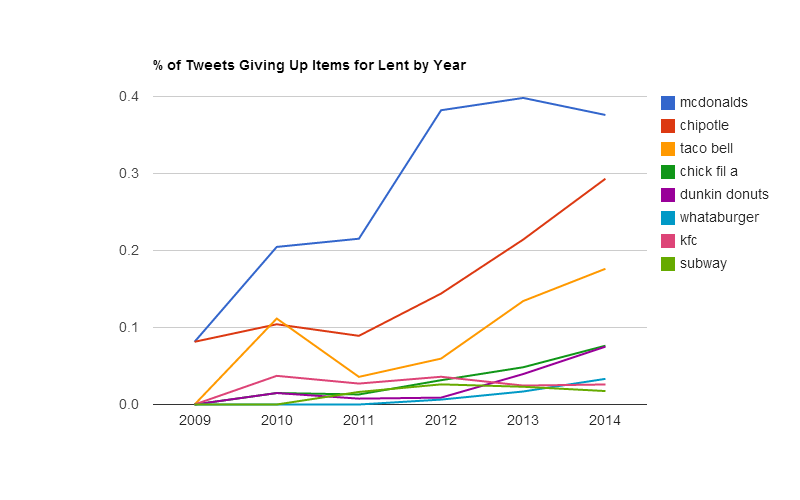
Chipotle is much higher on the list than I expected–is that because people love it or because they hate it?

McDonald's is highest, followed by Chipotle, Taco Bell, Chick-Fil-A, Dunkin Donuts, Whataburger, KFC, and Subway.

One Direction vs. Justin Bieber

One Direction has been outpacing Justin Bieber since 2012.

Snack Foods

Congratulations, Hot Cheetos, on being the snack the most people want to give up.

Hot Cheetos is highest, followed by popcorn, Doritos, potato chips, and Cheetos.

Media Coverage

The Lent Tracker got some media attention this year. In roughly chronological order:

Finally, this Wall Street Journal article doesn’t talk about the Lent tracker, but it discusses the fraught phenomenon of Ash Wednesday selfies: Selfies Bring Ashtags to Lent. (This article may or may not be behind a paywall for you.)

Posted in Lent, Twitter

"Hacking the Bible" in Christianity Today

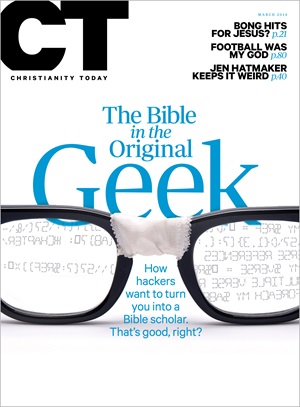
Read the article This month’s Christianity Today cover story, The Bible in the Original Geek, talks about how programmers are using technology to change how we read, study, and interpret the Bible. If you’re interested in the Bible and technology (and if you’re reading this blog, you probably are), then you should go read it.

(Ted Olsen, the author of the article, is doing also did an AMA on Reddit about the article.)

The article talks about the “academic priesthood,” and I think it’s particularly interesting that so few universities are interested in “digital theology” (for lack of a better term). You can study at Durham (like John Dyer is) or King’s College London, or you can try to work a biblical emphasis into a digital rhetoric Ph.D. But I’m surprised that more institutions, especially evangelical seminaries, aren’t at the forefront of the kind of research described in the article.

Posted in Education, Technology

Track What People Are Giving Up in 2014 for Lent in Real Time

See the top 100 things people are giving up in 2014 for Lent on Twitter, continually updated until March 7, 2014.

As I write this post, with about 5,000 tweets analyzed, the new hot topics so far this year are: “Netflix,” “Flappy Bird,” and “Getting an Oscar.” “Social Networking” is currently way out in front, with twice as many tweets as perennial favorites “Swearing” and “Alcohol.” (Last year, Social Networking came in at #4.)

Look for the usual post-mortem on March 8, 2014.

Posted in Lent, Twitter

Christmas Timeline Visualization

Christmas Timeline Visualization

Over at the Bible Gateway Blog, I have a post discussing the above Christmas Timeline Visualization, which uses the same xkcd-inspired format as the Holy Week Timeline from 2011.

Sequencing the events of the Christmas story in the Bible to produce this visualization raises a few questions I’d never considered before (not that they’re unique to me):

  1. When does Mary conceive Jesus? Everyone (including several commentaries) says that it happens before Mary goes to visit Elizabeth. John the Baptist's leap for joy in the womb is generally thought of as a response to Jesus' proximity, but the text says that Mary's voice prompts it. Even Elizabeth's blessing doesn't necessarily imply that Mary is already carrying Jesus.
  2. Did any of the shepherds who visited Jesus on the night of his birth have children whom Herod would later kill in the "Slaughter of the Innocents?" If so, that adds a chilling undertone to the story.
  3. Did the magi stay in the same inn at Bethlehem that didn't have room for Mary and Joseph?
  4. Why do angels always inspire movement? Every time they show up in the story, someone heads off somewhere.

Thanks to my assistant for putting together the spreadsheet (CSV) containing all the data used in the visualization.

Posted in Visualizations

So You Want to Write a Kids' Bible

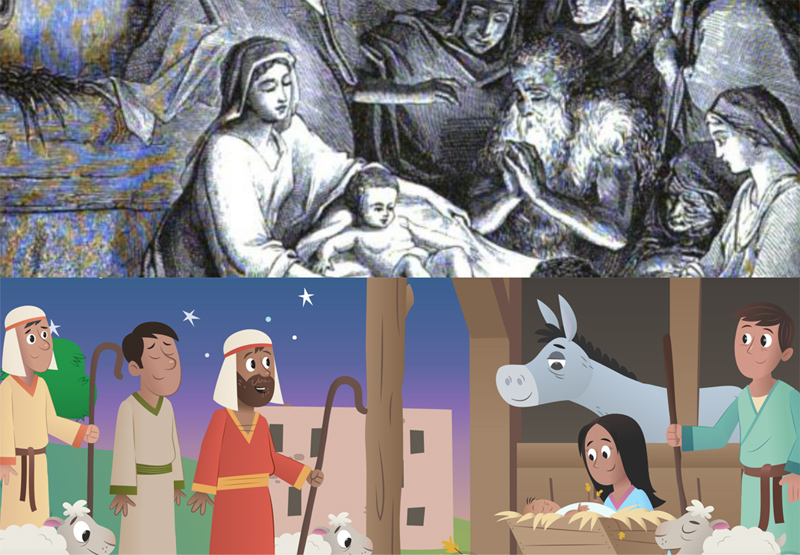
The Christmas story illustrated from 1880 and 2013. The bottom illustration is copyright Lifechurch.tv.

Let’s say you want to write a children’s Bible. When the time arrives to collect the stories you want to include, you need to choose which of the hundreds of tales in the Bible will make the cut. You can approach this decision a variety of ways: thematically (stories involving children, for example), artistically (stories that are illustratable), or even mathematically.

And by “mathematically,” I just mean “counting”–gather a bunch of kids’ Bibles, look at the tables of contents, and count the number of times that each story appears. Google Books speeds up this process; they include dozens of children’s Bibles in their index, some from the nineteenth century. My assistant went through over thirty Bibles for kids, copied out the tables of contents, and aligned all the stories. The resulting spreadsheet reflects around 415 unique stories that have appeared in kids’ Bibles over the past 180 years; around 350 of them show up in more than one kids’ Bible.

Show the complete list of popular stories from kids’ Bibles.

Most-Popular Old and New Testament Stories in Kids' Bibles

Old Testament Stories

  1. Noah's flood (Genesis 6-8)
  2. Moses' birth and being found by Pharaoh's daughter (Exodus 2:1-10)
  3. Joseph's coat, dreams, and sold by his brothers for twenty pieces of silver (Genesis 37)
  4. Ruth (Ruth 1-4)
    Creation of the world (Genesis 1:1-25)
  5. David and Goliath (1 Samuel 17)
  6. Capture of Jericho (Joshua 6)
    Crossing the Red Sea (Exodus 14)
    Daniel and the lions' den (Daniel 6)
  7. Burning bush (Exodus 3:1-4:17)
    David chosen by God (1 Samuel 16:1-13)
    The Ten Commandments (Exodus 20:1-17)

New Testament Stories

  1. Jesus' birth (Luke 2:7)
  2. Wise men visit Jesus (Matt 2:10-12)
  3. Jesus as a boy in the Temple (Luke 2:41-52)
    Jesus' crucifixion (Mark 15:22-40)
  4. Feeding of the 5,000 (Mark 6:32-44)
  5. Jesus and the children (Luke 18:15-17)
    Jesus chooses his disciples (Matt 4:18-22)
    Jesus calms the storm (Mark 4:35-41)
    Jairus' daughter (Luke 8:41-42, 49-56)
    The triumphal entry (Luke 19:28-44)
  6. Peter's miraculous escape from prison (Acts 12:1-19)
    The Last Supper (Mark 14:18-26)
    Sermon on the Mount (Matt 5)
    Jesus' ascension (Luke 24:51-53)
(Stories appearing under the same number in each column appear in an equal number of kids' Bibles.)

Some stories fall in and out of favor over time–compare the following list of top stories from the 1800s to the top stories from the 2000s. After looking at the below list, one person I talked to suggested that the composition of Bibles for children has become more theological recently and less focused on character-building.

Most-Popular Old and New Testament Stories in Kids' Bibles (1800s vs. 2000s)

Old Testament (1800s)

  1. Moses' birth and being found by Pharaoh's daughter (Exodus 2:1-10)
  2. Noah's flood (Genesis 6-8)
    Joseph's coat, dreams, and sold by his brothers for twenty pieces of silver (Genesis 37)
    Samson's death (Judges 16:23-31)
    Ruth (Ruth 1-4)
  3. Birth of Jacob and Esau (Genesis 25:19-26)
    Cain and Abel (Genesis 4)
    Sodom and Gomorrah (Genesis 18:16-19:29)
    David chosen by God (1 Samuel 16:1-13)
    Samson's birth (Judges 13)
    Samuel's birth (1 Samuel 1)
    Samson's marriage (Judges 14)

Old Testament (2000s)

  1. Noah's flood (Genesis 6-8)
    Creation of the world (Genesis 1:1-25)
    Daniel and the lions' den (Daniel 6)
  2. Burning bush (Exodus 3:1-4:17)
    Capture of Jericho (Joshua 6)
    Crossing the Red Sea (Exodus 14)
    David and Goliath (1 Samuel 17)
  3. Joseph's coat, dreams, and sold by his brothers for twenty pieces of silver (Genesis 37)
    David chosen by God (1 Samuel 16:1-13)
    Egypt's nine plagues (Exodus 7:14-10:29)
    The Ten Commandments (Exodus 20:1-17)
    Tower of Babel (Genesis 11:1-9)
    Moses' birth and being found by Pharaoh's daughter (Exodus 2:1-10)

New Testament (1800s)

  1. Jesus and the children (Luke 18:15-17)
    Peter's miraculous escape from prison (Acts 12:1-19)
    Jesus' birth (Luke 2:7)
    Jesus talks with the Samaritan Woman (John 4:4-42)
    Wise men visit Jesus (Matt 2:10-12)
    Jesus as a boy in the Temple (Luke 2:41-52)
    The triumphal entry (Luke 19:28-44)
  2. Bartimaeus sees (Mark 10:46-52)
    Jesus calms the storm (Mark 4:35-41)
    Jesus and the woman with bleeding (Luke 8:43-48)
    Parable of the good Samaritan (Luke 10:25-37)
    Parable of the prodigal son (Luke 15:11-32)
    Feeding of the 5,000 (Mark 6:32-44)
    The stoning of Stephen (Acts 7:54-60)
    Jairus' daughter (Luke 8:41-42, 49-56)
    Jesus' crucifixion (Mark 15:22-40)

New Testament (2000s)

  1. Jesus' birth (Luke 2:7)
  2. Wise men visit Jesus (Matt 2:10-12)
    Jesus' crucifixion (Mark 15:22-40)
  3. The Holy Spirit comes at Pentecost (Acts 2:1-13)
    Feeding of the 5,000 (Mark 6:32-44)
    The Last Supper (Mark 14:18-26)
    Sermon on the Mount (Matt 5)
  4. Jesus chooses his disciples (Matt 4:18-22)
    Jesus' temptation in the wilderness (Luke 4:1-13)
    The faith of the centurion (Luke 7:1-10)
    Jesus and the miraculous catch of fish (John 21:1-25)
    Shepherds visit Jesus (Luke 2:15-18)
    Parable of the good Samaritan (Luke 10:25-37)
    Peter heals the crippled beggar (Acts 3:1-10)
    Parable of the prodigal son (Luke 15:11-32)
    Saul's conversion (Acts 9:1-19)
    Jesus walks on water (Mark 6:48-53)
    Jesus changes water to wine (John 2:1-11)
    Zacchaeus (Luke 19:1-10)
    Jesus as a boy in the Temple (Luke 2:41-52)
    Jairus' daughter (Luke 8:41-42, 49-56)
    The triumphal entry (Luke 19:28-44)
    Gethsemane (Mark 14:32-42)
    Raising of Lazarus (John 11:1-45)
    Jesus' ascension (Luke 24:51-53)

The new Bible for Kids app from Lifechurch, out today, includes six stories: Creation, Fall, Jesus’ birth, Jesus heals a paralytic (the roof story), Jesus’ crucifixion, and Jesus’ resurrection. Aside from the story of the paralytic, all these stories are popular in recent Bibles for children.

Download the data

The raw data behind these lists is available as a Google Spreadsheet for you to download if you’re interested. For those books still in copyright, the contents of each book are copyright their respective authors.

Posted in Kids

Religious Interest among Facebook Users

I have a post on the Bible Gateway blog that briefly looks at how religious interest among Facebook users varies with age.

In particular, eighteen-year-old women appear to have an especially strong interest in religion, which drops off sharply during their 20s. (Barna in 2003 published findings that corroborate the dropoff.)

The post makes some possibly unwarranted inferences from the original data published yesterday by Stephen Wolfram:

quotes + life philosophy data by age

Posted in People, Technology

How to Train Your Franken-Bible

This is the outline of a talk that I gave earlier today at the BibleTech 2013 conference.

  • There are two parts to this talk
    • Inevitability of algorithmic translations. An algorithmic translation (or “Franken-Bible”) means a translation that’s at least partly done by a computer.
    • How to produce one with current technology.
  • The number of English translations has grown over the past five centuries and has accelerated recently. This growth mirrors overall trend in publishing as costs have diminished and publishers have proliferated.
  • I argue that this trend of ever-more translations will not only continue but will accelerate, that we’re heading for a post-translation world, where the number of English translations becomes so high, and the market so fragmented, that Bible translations as distinct identities will have much less meaning than they do today.
    • This trend isn’t specific to Bibles, but Bible translations participate in the larger shift to more diverse and fragmented cultural expressions.
  • Like other media, Bible translations are subject to a variety of pressures.
    • Linguistic (e.g., as English becomes more gender-inclusive, pressure rises on Bible translations to also become more inclusive).
    • Academic (discoveries that shed new light on existing translations). My favorite example is Matthew 17:15, where some older translations say, “My son is a lunatic,” while newer translations say, “My son has epilepsy.”
    • Theological / doctrinal (conform to certain understandings or agendas).
    • Social (decline in public religious influence leads to a loss of both shared stories and religious vocabulary).
    • Moral (pressure to address whatever the pressing issue of the day is).
    • Institutional (internally, where Bible translators want control over their translations; and externally, with the wider, increasing distrust of institutions).
    • Market. Bible translators need to make enough money (directly or indirectly) to sustain translation operations.
    • Technological. Technological pressure increases the variability and intensity of other pressures and is the main one we’ll be investigating today.
  • If you’re familiar with Clayton Christensen’s The Innovator’s Dilemma, you know that the basic premise is that existing dominant companies are eventually eclipsed by newer companies who release an inferior product at low prices. The dominant companies are happy to let the new company operate in this low-margin area, since they prefer to focus on their higher-margin businesses. The new company then steadily encroaches on the territory previously staked out by the existing companies until the existing companies have a much-diminished business. Eventually the formerly upstart company becomes the incumbent, and the cycle begins again.
    • One of the main drivers of this disruption is technology, where a technology that’s vastly inferior to existing methods in terms of quality comes at a much lower price and eventually supersedes existing methods.
  • I argue that English Bible translation is ripe for disruption, and that this disruption will take the form of large numbers of specialized translations that are, from the point of view of Bible translators, vastly inferior. But they’ll be prolific and easy to produce and will eventually supplant existing modern translations.
  • For an analogy, let’s look at book publishing (or any media, really, like news, music, or movies. But book publishing is what I’m most familiar with, so it’s what I’ll talk about). In the past twenty years, it’s gone through two major disruptions.
    • The first is a disruption in distribution, with Amazon.com and other web retailers. National bookstore chains consolidated or folded as they struggled to figure out how to compete with the lower prices and wider selection offered online.
    • This change hurt existing retailers but didn’t really affect the way that content creators like publishers and authors did business. From their perspective, selling through Amazon isn’t that different from selling through Barnes & Noble.
    • The second change is more disruptive to content creators: this change is the switch away from print books to ebooks. At first, this change seems more like a difference in degree rather than in kind. Again, from a publisher’s perspective, it seems like selling an ebook through Amazon is just a more-convenient way of selling a print book through Amazon.
    • But ebooks actually allow whole new businesses to emerge.
  • I’d argue that these are the main functions that publishers serve for authors--in other words, why would I, as an author, want a publisher to publish my book in exchange for some small cut of the profit?
    • Gatekeeping (by publishing a book, they’re saying it’s worth your time and has a certain level of quality: it's been edited and vetted).
    • Marketing (making sure that people know about and buy books that are interesting to them).
    • Distribution (historically, shipping print books to bookstores).
  • Ebooks most-obviously remove the distribution pillar of this model--when producing and distributing an epub only involves a few clicks, it’s hard to argue that a publisher is adding a whole lot of value in distribution.
  • That leaves gatekeeping and marketing, which I’ll return to later in the context of Bibles.
  • But beyond just affecting these pillars, ebooks also allow new kinds of products:
    • First, a wider variety of content becomes more economically viable--content that’s too long or too short to print as a book can work great as an ebook, for example.
    • Second, self-publishing becomes more attractive: when traditional publishing shuns you because, say, your book is terrible, just go direct and let the market decide just how terrible it is. And if no one will buy it, you can always give it away--it’s not like it’s costing you anything.
  • So ebooks primarily allow large numbers of low-quality, low-priced books into the market, which fits the definition of disruption we talked about earlier.
  • Let’s talk specifically about Bible translations.
  • Traditionally, Bible translations have been expensive endeavors, involving teams of dozens of people working over several years.
    • The result is a high-quality product that conforms to the translation’s intended purpose.
    • In return for this high level of quality, Bible publishers charge money to, at a minimum, recoup their costs.
  • What would happen if we applied the lessons from the ongoing disruption in book publishing to Bible translations?
    • First, like Amazon and physical bookstores, we disrupt distribution.
    • Bible Gateway in 1993 on the web first disrupted distribution by letting people browse translations for free.
    • YouVersion in 2010 on mobile then took that disruption a step further by letting people download and own translations for free.
    • But we’re really only talking about a disruption in distribution here. Just like with print books, this type of disruption doesn’t affect the core Bible-translation process.
  • That second type of disruption is still to come and will eventually arrive; I’m going to argue that, as with ebooks, the disruption to translations themselves will be largely technological and will result in an explosion of new translations.
    • I believe that this disruption will take the form of partially algorithmic personalized Bible translations, or Franken-Bibles.
    • Because Bible translation is a specialized skill, these Franken-Bibles won’t arise from scratch--instead, they’ll build on existing translations and will be tailored to a particular audience--either a single individual or a group of people.
  • In its simplest form, a Franken-Bible could involve swapping out a footnote reading for the reading that’s in the main text.
  • A typical Bible has around 1100 footnotes indicating alternate translations. What if a translation allowed you to decide which reading you preferred--either by setting a policy (for example, you might, say, “always translate adelphoi in a particular way”) or by deciding on a case-by-case basis.
  • By including footnote variants at all, translations have already set themselves up for this approach. Some translations go even further--the Amplified and Expanded Bibles embrace variants by embedding them right in the text. Here we see a more-extensive version of the same idea.
  • But that’s the simplest approach. A more-radical approach, from a translation-integrity perspective, would allow people to edit the text of the translation itself, not merely to choose among pre-approved alternatives at given points.
    • In many ways, the pastor who says in a sermon, “This verse might better be translated as...” is already doing this; it just isn’t propagated back into the translation.
    • People also do this on Twitter all the time, where they alter a few words in a verse to make it more meaningful to them.
    • The risk here, of course, is that people will twist the text beyond all recognition, either through incompetence or malice.
  • That risk brings us back to one of the other two functions that publishers serve: gatekeeping.
    • A translation is nothing if not gatekeeping: a group of people have gotten together and declared, “This is what Scripture says. These are our translation principles, and here’s where we stand in relation to other translations.”
    • What happens to gatekeeping--to the seal of authority and trust--when anyone can change the text to suit themselves?
  • In other words, what happens if the “Word of God” becomes the “Wiki of God?”
    • After all, people who aren’t interested in translating their own Bible still want to be able to trust that they’re reading an accurate, or at least non-heretical, translation.
  • I suggest that new axes of trust will form. Whereas today a translation “brand”--NIV, ESV, or whatever--carries certain trust signals, those signals will shift to new parties, and in particular to groups that people already trust.
    • The question of whom you’d trust to steward a Bible translation probably isn’t that different from whomever you already trust theologically, a group that probably includes some of the following:
      • Social network.
      • Teachers or elders in your church.
      • Pastors in your church.
      • Your denomination.
      • More indirectly, a megachurch pastor you trust.
      • A parachurch organization or other nonprofit.
      • Maybe even a corporation.
    • The point is not that trust in a given translation would go away, but rather that trust would become more networked, complicated, and fragmented, before eventually solidifying.
      • We already see this happening somewhat with existing Bible translations, where certain groups declare some translations as OK and others as questionable. Like your choice of cellphone, the translation you use becomes an indicator of group identity.
      • The proliferation of translations will allow these groups who are already issuing imprimaturs to go a step further and advance whole translations that fit their viewpoints.
      • In other words, they’ll be able to act as their own Magisteriums. Their own self-published Magisteriums.
      • This, by the way, also addresses the third function that publishers serve: marketing. By associating a translation with a group you already identify with, you reduce the need for marketing.
  • I said earlier that I think technology will bring about this situation, but there are a couple ways it could happen.
    • First, an existing modern translation could open itself up to such modifications. A church could say, “I like this translation except for these ten verses.” Or, “This translation is fine except that it should translate this Greek word this way instead of this other way.”
    • Such a flexible translation could provide the tools to edit itself--with enough usage, it’s possible that useful improvements could be incorporated back into the original translation.
  • A second alternative is to use technology to produce a new, cheap, low-quality translation with editing in mind from the get-go, to provide a base from which a monstrous hydra of translations can grow. Let’s take a look at what such a hydra translation, or a Franken-Bible, could look like.
  • The basic premise is this: there are around thirty modern, high-quality translations of the Bible into English. Can we combine these translations algorithmically into something that charts the possibility space of the original text?
    • Bible translators already consult existing translations to explore nuances of meaning. What I propose is to consult these translations computationally and lay bare as many nuances as possible.
  • You can explore the output of what I’m about to discuss at www.adaptivebible.com. I’m going to talk about the process that went into creating the site.
  • This part of the talk is pretty technical.
  • In all, there are fifteen steps, broken into two phases: alignment of existing translations and generation of a new translation.
  • It took about ten minutes of processor time for each verse to produce the result.
  • The total cost in server time on Amazon EC2 to translate the New Testament was about $10. Compared to the millions of dollars that a traditional translation costs, that’s a big savings--five or six orders of magnitude.
  • The first phase is alignment.
  • First step. Collect as many English translations as possible. Obviously there are copyright implications with doing that, so it’s important to deal with only one verse at a time, which is something that all translations explicitly allow. For this project, we used around thirty translations.
  • Second. Normalize the text as much as possible. For this project, we’re not interested in any formatting, for example, so we can deal with just the plain text.
  • Third. Tokenize the text and run basic linguistic analysis on it.
    • Off-the-shelf open-source software from Stanford called Stanford CoreNLP tokenizes the text, identifies lemmas (base forms of words) and analyzes how words are related to each other syntactically.
    • In general, it’s about 90% accurate, which is fine for our purposes; we’ll be trying to enhance that accuracy later.
  • Fourth. Identify Wordnet similarities between translations.
    • Wordnet is a giant database of word meanings that computers can understand.
    • We take the lemmas from the step 3 and identify how close in meaning they are to each other. The thinking is that even when translations use different words for the same underlying Greek word, the words they choose will at least be similar in meaning.
    • For this step, we used Python’s Natural Language Toolkit.
  • Fifth. Run an off-the-shelf translation aligner.
    • We used another open-source program called the Berkeley Aligner, which is designed to use statistics to align content between different languages. But it works just as well for different translations of the same content in the same language. It takes anywhere from two to ten minutes for each verse to run.
  • Sixth. Consolidate all this data for future processing.
    • By this point, we have around 4MB of data for each verse, so we consolidate it into a format that’s easy for us to access in later steps.
  • Seventh. Run a machine-learning algorithm over the data to identify the best alignment between single words in each pair of translations.
    • We used another Python module, scikit-learn, to execute the algorithm.
    • In particular, we used Random Forest, which is a supervised-learning system. That means we need to feed it some data we know is good so that it can learn the patterns in the data.
  • Where did we get this good data? We wrote a simple drag-and-drop aligner to feed the algorithm, where there are two lists of words and you drag them on top of each other if they match; it’s actually kind of fun: if you juiced it up a little, I can totally see it becoming a game called “Translations with Friends.”
    • In total, we hand-aligned around 30 pairs of translations across 25 verses. There are about 8,000 verses in the New Testament, so it doesn’t need a lot of training to get good results.
  • What the algorithm actually runs on is a big vector matrix. These are the ten factors we included in our matrix.
    • 1. One translation might begin a verse with the words “Jesus said,” while another might put that same phrase at the end of the verse. All things being equal, though, translations tend to put words in similar positions in the verse. When all else fails, it’s worth taking position into account.
    • 2. Similarly, even when translations rearrange words, they’ll often keep them in the same sentence. Again, all things being equal, it’s more likely that the same word will appear in the same sentence position across translations.
    • 3. If we know that a particular word is in a prepositional phrase, for example, it’s not unlikely that it will serve a similar grammatical role in another translation.
    • 4. If words in different translations are both nouns or both verbs, it’s more likely that they’re translating the same word than if one’s a noun and another’s an adverb.
    • 5. Here we use the output from the Berkeley Aligner we ran earlier. The aligner is bidirectional, so if we’re comparing the word “Jesus” in one translation with the word “he” in another, we look both at what the Berkeley Aligner says “Jesus” should line up with in one translation and with what “he” should line up with in the other translation. It provides a fuller picture than just going in one direction.
    • 6. Here we go more general. Even if the Berkeley Aligner didn’t match up “Jesus” and “he” in the two translations we’re currently looking at, if other translations use “he” and the Aligner successfully aligned them with “Jesus”, we want to take that into account.
    • 7. This is similar to grammatical context but looks specifically at dependencies, which describe direct relationships between words. For example, if a word is the subject of a sentence in one translation, it’s likely to be the subject of a sentence in another translation.
    • 8. Wordnet similarity looks at the similarities we calculated earlier--words with similar meanings are more likely to reflect the same underlying words.
    • 9. This step strips out all words that aren’t nouns, pronouns, adjectives, verbs, and adverbs and compares their sequence--if a different word appears between two identical words across translations, there’s a good chance that it means the same thing.
    • 10. Finally, we look at any dependencies between major words; it’s a coarser version of what we did in #7.
    • The end result a giant matrix of data--ten vectors for every word-combination in every translation in every verse--and we run our machine-learning algorithm on it, which produces an alignment between every word in every translation.
    • At this point, we’ve generated between 50 and 250MB of data for every verse.
  • Eighth. Now that we have the direct alignment, we supplement it with indirect alignment data across translations. In other words, to reuse our earlier example, the alignment between two translations may not align “Jesus” and “he,” but alignments in other translations might strongly suggest that the two should be aligned.
  • At this point, we have a reasonable alignment among all the translations. It’s not perfect, but it doesn’t have to be. Now we shift to the second phase: generating a range of possible translations from this data.
  • First. Consolidate alignments into phrases, where we look for runs of parallel words. You can see that we’re only looking at lemmas here--dealing with every word creates a lot of noise that doesn’t add much value, so we ignore the less-important words. In this case, the first two have identical phrases even though the words differ slightly, while the third structures the sentence differently.
  • Second. Arrange translations into clusters based on how similar they are to each other structurally. In this example, the first two form a cluster, and the the third would be part of a different cluster.
  • Third. Insert actual keyword text. I’ve been using words in the examples I’ve been giving, but in the actual program, we use numerical ids assigned to each word. Here we start to introduce actual words.
  • Fourth. Fill in the gaps between keywords. We add in small words like conjunctions and prepositions that are key to producing recognizable English.
  • Fifth. Add in punctuation. Up to this point, we’ve been focusing on the commonalities among translations. Now we’re starting to focus on differences to produce a polished output.
  • Sixth. Reduce the possibility space to accept only valid bigrams. “Bigrams” just means two words in a row. We remove any two-word combinations that, based on our algorithm thus far, look like they should work but don’t. We check each pair of words to see whether they exist anywhere in one of our source translations. If they don’t, we get rid of them.
  • Seventh. Produce rendered output.
  • In this case, the output is just for the Adaptive Bible website. It shows the various translation possibilities for each verse.
    • Hovering over a reading shows what the site thinks are valid next words based on what you’re hovering over. (That’s the yellow.)
    • You can click a particular reading if you think it’s the best one, and the other readings disappear. Clicking again restores them. (That’s the green.)
    • The website shows a single sentence structure that it thinks has the best chance of being valid, but most verses have multiple valid structures that we don’t bother to show here.
  • To consider a verse successfully translated, this process has to produce readings supported by two independent translation streams (e.g., having a reading supported only by ESV and RSV doesn’t count because ESV is derived from RSV).
    • Using this metric, the process I’ve described produces valid output for 96% of verses in the New Testament.
    • On the current version of adaptivebible.com, I use stricter criteria, so only 91% of verses show up.
  • Limitations
    • Just because a verse passes the test, that doesn’t mean it’s actually grammatical, and it certainly doesn’t mean that every alternative presented within a verse is valid.
    • Because we use bigrams for validity, we can get into situations like what you see here, where all these are valid bigrams, but the result ("Jesus said, 'Be healed,' Jesus said") is ridiculous.
    • There’s no handling of inter-verse transitions; even if a verse is totally valid, it may not read smoothly into the next verse.
    • Since we removed all formatting at the beginning of the process, there’s no formatting.
  • Despite those limitations, the process produced a couple of mildly interesting byproducts.
  • Probabilistic Strongs-to-Wordnet sense alignment. Given a single Strong’s alignment and a variety of translations, we can explore the semantic range of a Strong’s number. Here we have dunamis. This seems like a reasonably good approximation of its definition in English.
  • Identifying translation similarity. This slide explores how structurally similar translations are to each other, based on the phrase clusters we produced. The results are pretty much what I’d expect: translations that are derived from each other tend to be similar to each other.
  • What I’ve just described is one pretty basic approach to what I think is inevitable: the explosion of translations into Franken-Bibles as technology gets better. In the future, we won’t be talking about particular translations anymore but rather about trust networks.
  • To be clear, I’m not saying that I think this development is a particularly great one for the church, and it’s definitely not good for existing Bible translations. But I do think it’s only a matter of time until Franken-Bibles arrive. At first they’ll be unwieldy and ridiculously bad, but over time they’ll adapt, improve, and will need to be taken seriously.

Posted in Collective Intelligence, Linguistics, Technology