Blog

What Twitterers Are Giving up for Lent (2013 Edition)

The top 100 things that people on Twitter are giving up for Lent in 2013.

This year saw a lot of churn in the top 100 things people were giving up for Lent.

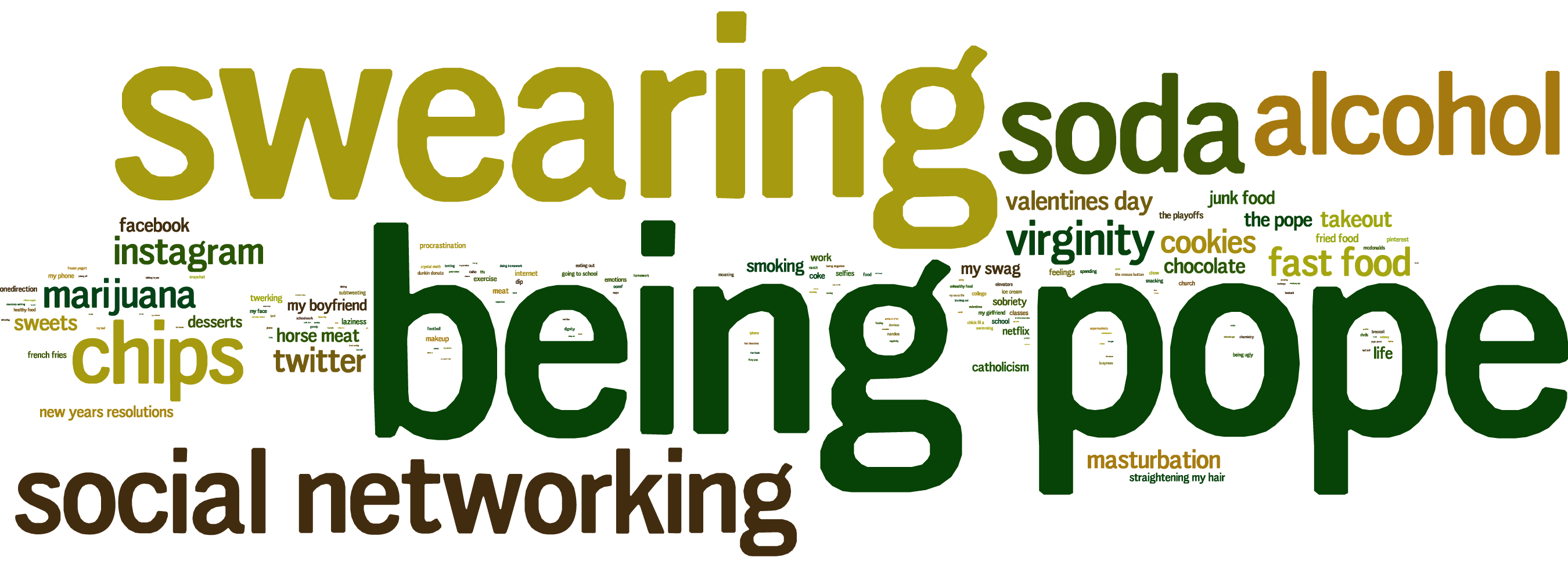
The pope announced his resignation on Monday, leading many to say that he was giving up “being pope” for Lent. It came in at #1. (Related, at #18, people said they were giving up “the pope” for Lent.)

Specific social networking sites like Twitter and Facebook generally dropped this year, with the generic term “social networking” (#4) taking over as a catchall. Instagram (#10), Pinterest (#52), and Snapchat (#78) were all new to the top 100.

With Valentine’s Day falling on the day after Ash Wednesday this year, it came in at #13. My wife suggests that the timing may also have contributed to the drop in “chocolate” from #2 last year to #17 this year. “Valentines” is #97.

“Horse meat” (#20) refers to the ongoing European scandal.

The only celebrity to make the list was British boy band One Direction, up substantially at #41.

I learned several new words this year: “twerking” (#34), a type of dance move, “selfies” (#46), or self-shot photos taken with a phone, “subtweeting” (#57), or tweeting about someone without mentioning them by name, “oomf” (#71), or “one of my [Twitter] followers,” and “Nando’s” (#76), a chicken restaurant.

This list draws from 263,000 tweets from February 10-15, 2013, and excludes most retweets.

RankWordCountChange from last year’s rank
1.Being pope5,654 
2.Swearing4,944+1
3.Soda2,648+2
4.Social networking2,264+19
5.Alcohol2,217-1
6.Chips1,690+8
7.Virginity933+23
8.Marijuana784+17
9.Fast food776-2
10.Instagram755+270
11.Twitter672-10
12.Cookies643+19
13.Valentine's day514 
14.Masturbation510+18
15.Takeout465+59
16.Sweets444-7
17.Chocolate417-15
18.The pope394+10,224
19.Facebook380-13
20.Horse meat375 
21.Junk food362-8
22.Smoking355-3
23.My swag331+373
24.Desserts325+21
25.Life325+40
26.New year's resolutions313+47
27.My boyfriend309+99
28.Catholicism255+11
29.Straightening my hair228+89
30.Fried food225+5
31.Netflix216+255
32.Work216-5
33.Sobriety213+4
34.Twerking185+698
35.The playoffs184+3,556
36.French fries173+19
37.Coke168+1
38.Feelings168+207
39.Laziness160+28
40.Meat158-30
41.Onedirection155+103
42.You154-24
43.Procrastination153+1
44.Makeup150+16
45.Internet149+61
46.Selfies149+2,328
47.Exercise144+58
48.School141-36
49.My phone135+15
50.Classes129+84
51.Dip127+132
52.Pinterest125+133
53.Church124+33
54.Emotions122+397
55.Going to school119+163
56.My girlfriend111+207
57.Subtweeting110+253
58.College106+5
59.My face106+4,168
60.Ice cream106-27
61.McDonald's102-32
62.Being ugly101+256
63.Snacking99+19
64.Spending96+89
65.Dunkin Donuts96+475
66.Chew95+418
67.Eating out94+28
68.Elevators94+99
69.Food93-47
70.Moaning93+123
71.Oomf93+78
72.Chick Fil A90+135
73.Healthy food88+180
74.Football87+145
75.Swimming87+200
76.Nando's86+72
77.DVDs84+1,326
78.Snapchat84 
79.Broccoli83+206
80.Ranch81+250
81.The snooze button80+176
82.Crystal meth80+219
83.Dignity79+116
84.Cake77-13
85.Unhealthy food77+34
86.Homework76-65
87.Busyness75 
88.Schoolwork74+88
89.Chemistry74+34,949
90.Frozen yogurt72+480
91.iPhone72+100
92.FIFA71+143
93.Betting70+315
94.Doing homework69+158
95.Myself68+267
96.Supermarkets67+1,797
97.Valentines66 
98.Domino's63+323
99.Being negative63+212
100.Hookah63+340

Categories

RankCategoryNumber of Tweets
1.food11,642
2.habits8,083
3.religion6,519
4.technology4,782
5.smoking/drugs/alcohol3,928
6.sex1,771
7.relationship1,399
8.health/hygiene1,270
9.school work1,095
10.irony792
11.sports648
12.entertainment392
13.celebrity246
14.clothes235
15.money133
16.shopping111

The image is a Wordle.

Posted in Lent, Twitter

Street View through Israel

Google yesterday announced that they’ve expanded their street view functionality throughout Israel, including a number of sites that you’d visit on any tour of the Holy Lands. Of particular note are the archaeological sites they walked around and photographed. Here, for example, is Megiddo:


View Larger Map

Previously available were many places in Jerusalem, like the Via Dolorosa. But the new imagery covers much more area–I can imagine it being particularly useful in Sunday School and classroom settings, where a semi-immersive environment communicates more than static photographs.

Via Biblical Studies and Technological Tools.

Posted in Geo, Virtual Reality

Bible Reference Parser Code Update

The semiannual release schedule of the Javascript Bible Passage Reference Parser continues. This release:

  • Improves support for parentheses.
  • Adds some alternate versification systems.
  • Supports French book names.
  • Removes the "docs" folder because it was getting unwieldy; the source itself remains commented.
  • Reorganizes some of the source code.
  • Increases the number of real-world strings from 200,000 to 370,000. I ran the parser on all 85 million tweets and Facebook posts in the Realtime Bible Search database to produce the list.

One of the main goals of this parser is to give you a starting point to build your own parser, so the source is thoroughly documented and has many tests you can use to validate your code.

Try a demo or browse the source on GitHub.

Posted in Code

Zoomable Map of the Greco-Roman World

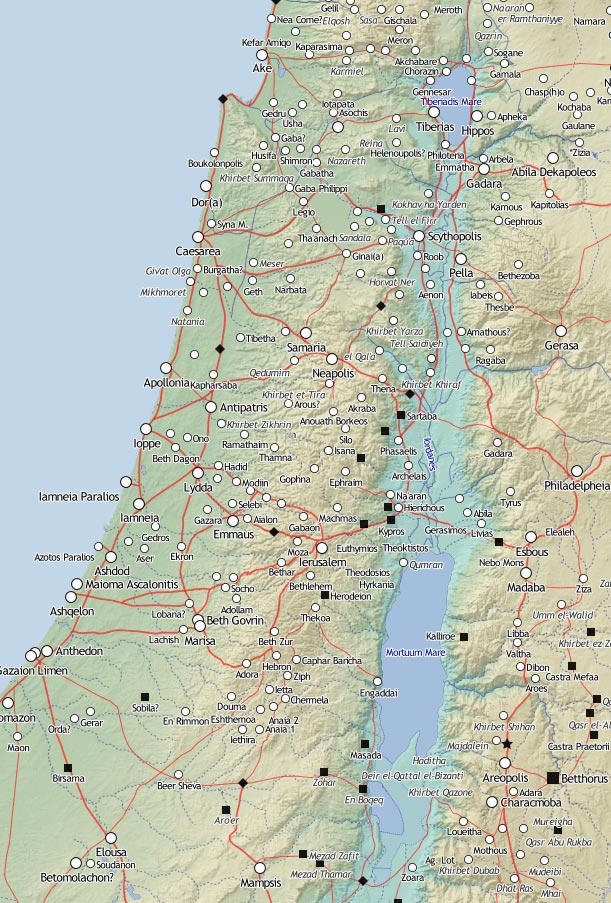
The Pelagios Project has produced a lovely zoomable map of the Greco-Roman world. Below, for example, is a static view of Israel during the Roman period.

A blog post about the map discusses how they created it (plus bonus technical background). I’m most impressed by how attractive the maps are—a lot of online maps present you the data but don’t try to be beautiful; this map succeeds on both counts.

More generally, the Pelagios Project, which I admit I hadn’t heard of before today, incorporates linked data to help people study the ancient world. It encompasses a variety of efforts (need to search for an inscription from ancient Palestine? No problem)—it’s all fascinating.

Terrain-shaded map of Roman Palestine (Israel) showing topography, cities, roads, and other features. (Note the “Mortuum Mare” instead of the “Dead Sea.”)

Via O’Reilly Radar.

Posted in Geo

Calculating the Time and Cost of Paul's Missionary Journeys

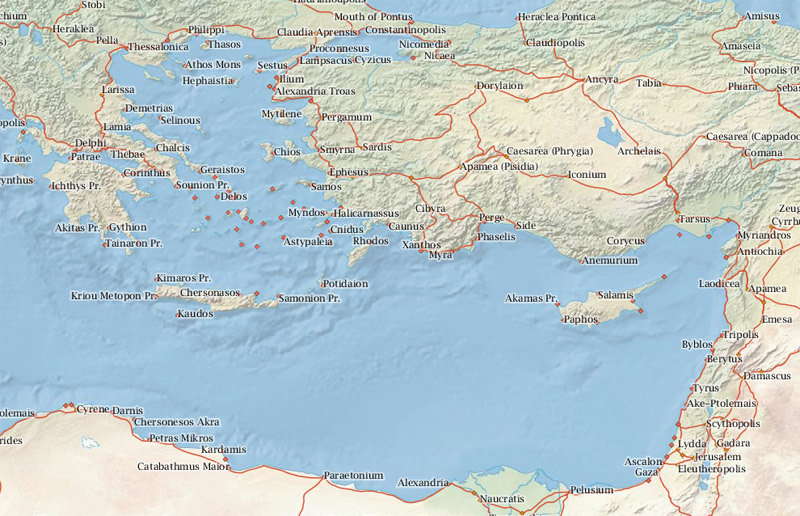
Stanford University recently unveiled ORBIS, a site that lets you calculate the time and cost required to travel by road or ship around the Roman world in A.D. 200. It takes into account a lot of factors—my favorite is that it models ancient sea routes based on historical sources and wave height.

A view of the Mediterranean, including Roman cities and roads, from ORBIS.

The apostle Paul went on three missionary journeys from A.D. 46 to 57, traveling around much of Asia Minor and Greece. In 60, he was also taken to Rome. ORBIS allows us to calculate how long these journeys would have taken in pure travel time (excluding time spent at each destination) and how much they would have cost.

JourneyDistance (miles)Travel Time (days)Cost per Person (denarii)*
First1,58153237
Second3,050100314
Third3,30792481
Rome2,34436699
* Ship travel only. According to Wikipedia, the denarius from 200, used here, is roughly 22% weaker than a denarius from the mid-first-century.

I conclude a few things from this exercise:

  1. The journeys get progressively costlier as more of each journey happens by ship. Sailing is fast but expensive---of course, Paul and his companions may not have had to pay the full fare.
  2. I like to imagine that Paul's overnight escape from Thessalonica to Berea was partially by riverboat (though the costs above assume it was by road).
  3. Not much of the route of Paul's journey is in doubt---Luke describes the trips pretty precisely in Acts. About the only question is whether Paul traveled from Berea to Athens by ship or by road. The above costs follow the ESV Study Bible and assume it was by ship.

For more about Paul’s missionary journeys, Dale Bargmann has written a good walkthrough with maps and photos.

Download the raw data (Excel).

Posted in Geo

Rise of the Robosermon

In a recent issue of Wired, Steven Levy writes about Narrative Science, a company that uses data to write automated news stories. Right now, they mostly deal in data-intensive fields like sports and finance, but the company is confident that it will easily expand into other areas—the company’s co-founder even predicts that an algorithm will win a Pulitzer Prize in the next five years.

In February 2012, I attended a session at the TOC Conference given in part by Kristian Hammond, the CTO and co-founder of Narrative Science. During the session, Hammond mentioned that sports stories have a limited number of angles (e.g., a “blowout win” or a “come-from-behind victory”)—you can probably sit down and think up a fairly comprehensive list in short order. Even in fictional sports stories, writers only use around sixty common tropes as part of the narrative. Once you have an angle (or your algorithm has decided on one), you just slot in the relevant data, add a little color commentary, and you have your story.

At the time, I was struggling to understand how automated content could apply to Bible study; Levy’s article leads me to think that robosermons, or sermons automatically generated by a computer program, are the way of the future.

Parts of a Robosermon

Futurama has a robot preacher. I've never seen these episodes, so hopefully this image isn't terribly heretical. After all, from a data perspective, sermons don’t differ much from sports stories. In particular, they have three components:

First, as with sports stories, sermons follow predictable structures and patterns. David Schmitt of Concordia Theological Seminary suggests a taxonomy of around thirty sermon structures. Even if this list isn’t comprehensive, it would probably take, at most, 100 to 200 structures to categorize nearly all sermons.

Second, sermons deal with predictable content: whereas sports have box scores, sermons have Bible texts and topics. A sermon will probably deal with a passage from the Bible in some way—the 31,000 verses in the Bible comprise a large but manageable set of source material (especially since most sermons involve a passage, not a single verse; you can probably cut this list down to around 2,000 sections). Topically, SermonCentral.com lists only 500 sermon topics in their database of 120,000 sermons. The power-law popularity distribution (i.e., the 80/20 rule) of verses preached on (on SermonCentral.com are 1,200 sermons on John 1 compared to seven on Numbers 35) and topics (1,400 sermons on “Jesus’ teachings” vs. four on “morning”) means that you can categorize most sermons using a small portion of the available possibilities.

Third, sermons generally involve illustrations or stories, much like the color commentary of sports stories. Finding raw material for illustrations shouldn’t present a problem to a computer program; a quick search on Amazon turns up 1,700 books on sermon illustrations and an additional 10,000 or so on general anecdotes. You can probably extract hundreds of thousands of illustrations from just these sources. Alternately, if a recent news story relates to your topic, the system can add the relevant parts to your sermon with little trouble (especially if a computer wrote the news story to begin with).

Application

You end up being able to say, “I want to preach a sermon on Philippians 2 that emphasizes Christ’s humility as a model for us.” Then—and here’s the part that doesn’t exist yet but that technology like Narrative Science’s will provide—an algorithm suggests, say, an amusing but poignant anecdote to start with, followed by three points of exegesis, exhortation, and application, and finishing with a trenchant conclusion. You tweak the content a bit, throwing in a shout-out to a behind-the-scenes parishioner who does a lot of work but rarely receives recognition, and call it done.

Why limit sermons to pastors, though? Why shouldn’t churchgoers be able to ask for custom sermons that fit exactly their circumstances? “I’d like a ten-part audio sermon series on Revelation from a dispensational perspective where each sermon exactly fits the length of my commute.” “Give me six weeks of premarital devotions for my boyfriend and me. I’ve always been a fan of Charles Spurgeon, so make it sound like he wrote them.”

Levy opens his Wired article with an anecdote about how grandparents would find articles about their grandchildren’s Little League games just as interesting as “anything on the sports pages.” He doesn’t mention that what they really want is a recap with their grandchild as the star (or at least as a strong supporting character—it’s like one of those children’s books where you customize the main character’s name and appearance). Robosermons let you tailor the sermon’s content so that your specific problems or questions form the central theme.

The logical end of this technology is a sermonbot that develops a following of eager listeners and readers, in the same way that an automated newspaper reporter would create fans on its way to winning a Pulitzer.

You may argue that robosermons diminish the role of the Holy Spirit in preparing sermons, or that they amount to plagiarism. I’m not inclined to disagree with you.

Conclusion

Building a robosermon system involves five components: (1) sermon structures; (2) Bible verses; (3) topics; (4) illustrations; and (5) technology like Narrative Science’s to put everything together coherently. It would also be helpful to have (6) a large set of existing sermons to serve as raw data. It’s a complicated problem but hardly an insurmountable one over the next ten years, should someone want to tackle it.

I’m not sure they should; that way lies robopologetics and robovangelism.

If you’re not an algorithm and you want to know how to prepare and deliver a sermon, I suggest listening to this 29-part course on preaching by Bryan Chapell at Biblical Training. It’s free and full of homiletic goodness.

Posted in AI, Churches, Sermons, Technology

What Twitterers Are Giving up for Lent (2012 Edition)

The top 100 things that people on Twitter are giving up for Lent in 2012.

This year, Twitter continues to take top honors. Facebook drops a few places compared to last year–has it become less-central to people’s lives? This year’s hot new site, Pinterest, almost makes the list, showing up at #118. (Incidentally, Pinterest has a number of Lent-related boards.)

Chocolate comes in at #2–however, if you add up all the mentions of chocolate in its various forms (“chocs,” “chocolate chips,” etc.), it totals over 14,000 mentions, enough to put it at #1.

This year’s biggest gainers are “breathing” and “makeup,” both of which jumped up more than 30 places in the list.

No celebrities make the top 100 this year. Boy band One Direction (aka #1D) is at #144, followed by Justin Bieber at #194 and Tim Tebow at #221. Last year’s curiosity, Charlie Sheen, only got two mentions; he dropped to #10,000 or so.

Overall, food was by far the most popular thing given up.

This list draws from about 300,000 tweets from February 19-25, 2012, and excludes retweets.

RankWordCountChange from last year’s rank
1.Twitter13,9370
2.Chocolate13,001+1
3.Swearing11,737+1
4.Alcohol9,998+1
5.Soda9,942+2
6.Facebook9,025-4
7.Fast food6,529+3
8.Sex6,146-2
9.Sweets4,973+2
10.Meat4,444-1
11.Lent4,171-3
12.School3,976+1
13.Junk food3,388+6
14.Chips3,150+4
15.Coffee2,2630
16.Candy2,217+6
17.Bread2,124+3
18.You2,056-2
19.Smoking2,002+2
20.Giving up things2,001-8
21.Homework1,908+11
22.Food1,800+5
23.Social networking1,754-6
24.Religion1,701-10
25.Marijuana1,594+4
26.Beer1,359+4
27.Work1,331-3
28.Stuff1,302-3
29.McDonald's1,249+21
30.Virginity1,152+7
31.Cookies1,137+3
32.Masturbation1,134+4
33.Ice cream1,113+15
34.Shopping1,068-6
35.Fried food993-4
36.Boys956+6
37.Sobriety910+7
38.Coke899+3
39.Catholicism881-13
40.Cheese858-7
41.Nothing831+5
42.Carbs818+16
43.Red meat758-8
44.Procrastination738+1
45.Desserts733+26
46.Pizza714+15
47.Pancakes650-9
48.Sugar645-5
49.Rice633-10
50.Breathing631+34
51.Me628+12
52.Texting627+3
53.Starbucks623+1
54.Fizzy drinks595+12
55.French fries593+7
56.Diet Coke572+21
57.Porn562+10
58.Tumblr548+12
59.Wine546-7
60.Makeup539+31
61.Liquor534-5
62.Booze530-22
63.College524+18
64.My phone508+30
65.Life486 
66.Caffeine466-17
67.Laziness453+11
68.Chipotle452+30
69.Tea445+6
70.Chicken442+2
71.Cake440+3
72.Sarcasm429+4
73.New Year's resolutions422+15
74.Takeout417+11
75.Men412-10
76.Pork394-3
77.Christianity388-18
78.Sleep386+1
79.People384+8
80.Caring377 
81.Juice357+11
82.Snacking345 
83.Lying333 
84.TV332-31
85.Complaining331-2
86.Church328-35
87.Him327+2
88.Sweet tea326 
89.Lint326-21
90.Vegetables324 
91.Talking323 
92.Bacon321 
93.Being mean320 
94.Pasta316 
95.Eating out316+5
96.Negativity314-39
97.Eating298 
98.Biting my nails294 
99.Nutella291 
100.Being nice258 

Categories

RankCategoryNumber of Tweets
1.food79,977
2.habits21,836
3.technology19,190
4.smoking/drugs/alcohol19,073
5.health/hygiene11,101
6.sex9,948
7.irony9,352
8.school/work8,567
9.relationship6,919
10.religion4,157
11.generic2,841
12.shopping1,491
13.entertainment1,344
14.money526
15.sports512
16.celebrity461
17.possessions376
18.clothes111
19.politics105

The image is a Wordle.

Posted in Lent, Twitter