Ray Fowler analyzes Amazon’s Kindle data to find the most-highlighted Bible passages on Kindle.
Ten of the fourteen verses overlap the thirty most popular verses on Twitter, a higher percentage than I expected.
Ray Fowler analyzes Amazon’s Kindle data to find the most-highlighted Bible passages on Kindle.
Ten of the fourteen verses overlap the thirty most popular verses on Twitter, a higher percentage than I expected.
Posted in Collective Intelligence
Here’s a visualization of 340,000 Bible cross references:
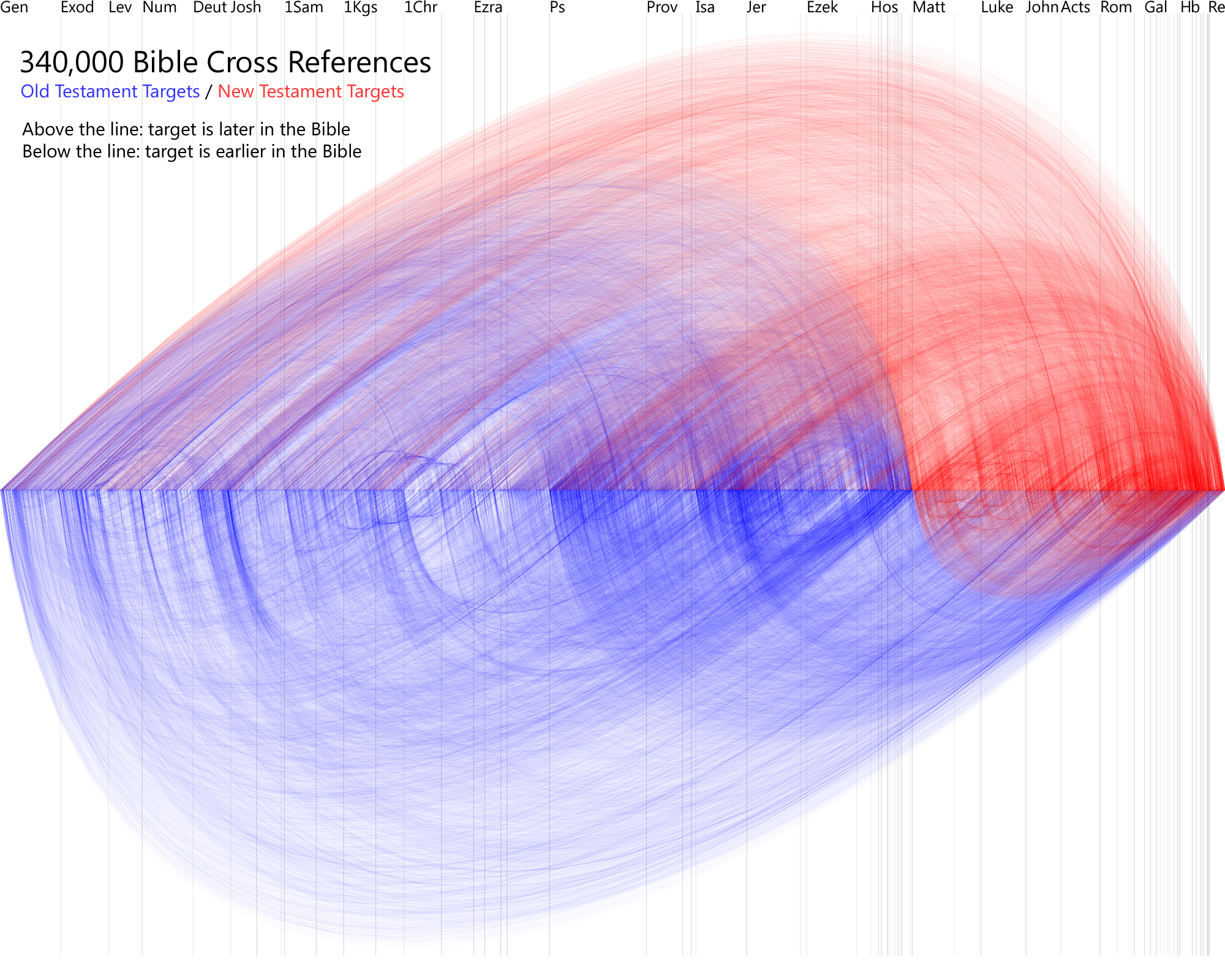 Larger version (2,000 x 1,600 pixels).
Does anything strike you as intriguing? A few trends jump out at me:
You can also download the full-size image (10,000 x 8,000 pixels, 75 MB PNG). It’s a very large image that could crash your browser. If you want it, I strongly recommend that you save it to your computer rather than trying to open it in your browser.
This visualization uses data from the Bible Cross References project. I used PHP’s GD library to create the graphic.
Inspired by Chris Harrison and Christian Swinehart’s wonderful Choose Your Own Adventure work.
Posted in Cross References, Visualizations
Browse 340,000 Bible cross references. Make the list better by voting on relevant or irrelevant verses.
For example, try Philippians 4:13 (“I can do all things through Christ who strengthens me”) or Isaiah 40:31 (“They shall mount up on wings like eagles”).
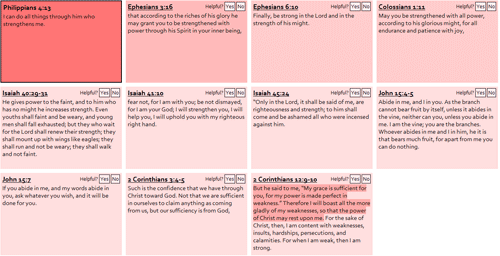
The interface is about as bare-bones as it gets: there’s a list of cross references for a single Bible verse, sorted by relevance (i.e., votes). You can browse to related verses, vote on whether each cross reference is relevant, and see (on external sites) the verses in different translations. It also prints nicely. There’s no way to suggest new cross references, though I may add that feature if there’s demand.
The data comes primarily from The Treasury of Scripture Knowledge (TSK) but blends other data, including the Topical Bible and Twitter Bible Search. All the copies of TSK on the web seem to descend from one source; I did some basic cleaning of the data and extracted the references. Then I blended the other data to weight some cross references more highly than others—that’s where the initial vote counts come from. (Incidentally, I only count around 380,000 cross references in TSK, lower than the usual count of 500,000 cross references you find when people talk about TSK. The lower number of cross references on this site–340,000–comes mostly from removing duplicates and combining adjacent verses.)
The 340,000 cross references in this data are a substantial number–most cross reference systems in print Bibles contain 50,000-100,000 cross references. While this list is more comprehensive, the tradeoff is that some of the cross references are less relevant than you find in print Bibles. As people use this site, however, the most-relevant verses should rise to the top.
The main limitation to the data is that the cross references always point from a single verse rather than from a range of verses: in other words, from Matthew 5:3 instead of from Matthew 5:3-11. Broader cross references—references that apply to a complete passage—are therefore missing from the data, limiting its usefulness somewhat.
The lack of an open, high-quality source of Bible cross references on the web has always bewildered me. This project is an attempt to remedy that deficiency. Feel free to download the raw cross-reference data (2 MB .zip, updated regularly with the latest vote counts) and use it in your projects.
Update April 12, 2010: Fred Sanders at Scriptorium Daily has a great introduction to the Treasury of Scripture Knowledge if you want more background on this work.
Posted in Cross References
Here’s a presentation I just gave at the BibleTech 2010 conference about how people tweet the Bible:
Also: PowerPoint, PDF.
I distributed the following handout at the presentation, showing the popularity of Bible chapters and verses cited on Twitter. It displays a lot of data: darker chapters are more popular, the number in the middle of each box is the most popular verse in the chapter, and sparklines in each box show the distribution of the popularity in each chapter. (Genesis 1:1 is by far the most popular verse in Genesis 1, while Genesis 3:15 is only a little more popular than other verses in the chapter.)

Posted in Bible, Twitter, Visualizations
Let’s look a little more at some of the data on what Twitterers are giving up for Lent.
 Size indicates the relative number of Twitterers in each country giving up something for Lent.
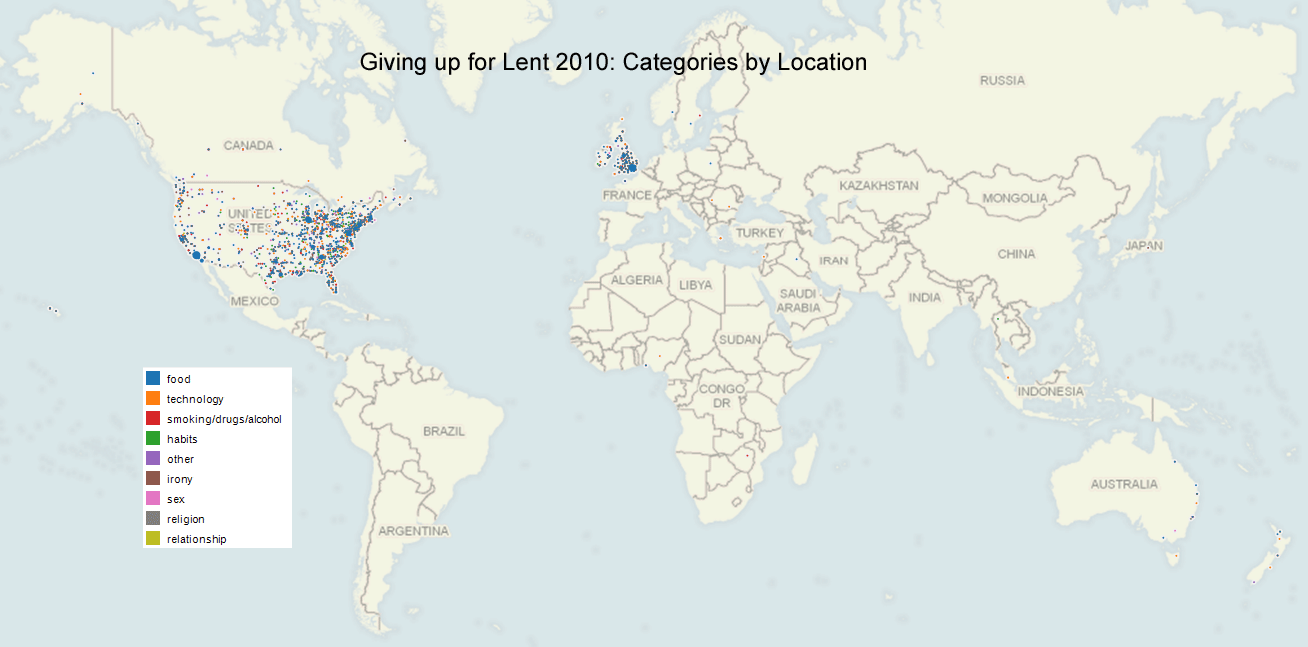
These visualizations show the differences (or lack thereof) in what people are giving up among U.S. states.
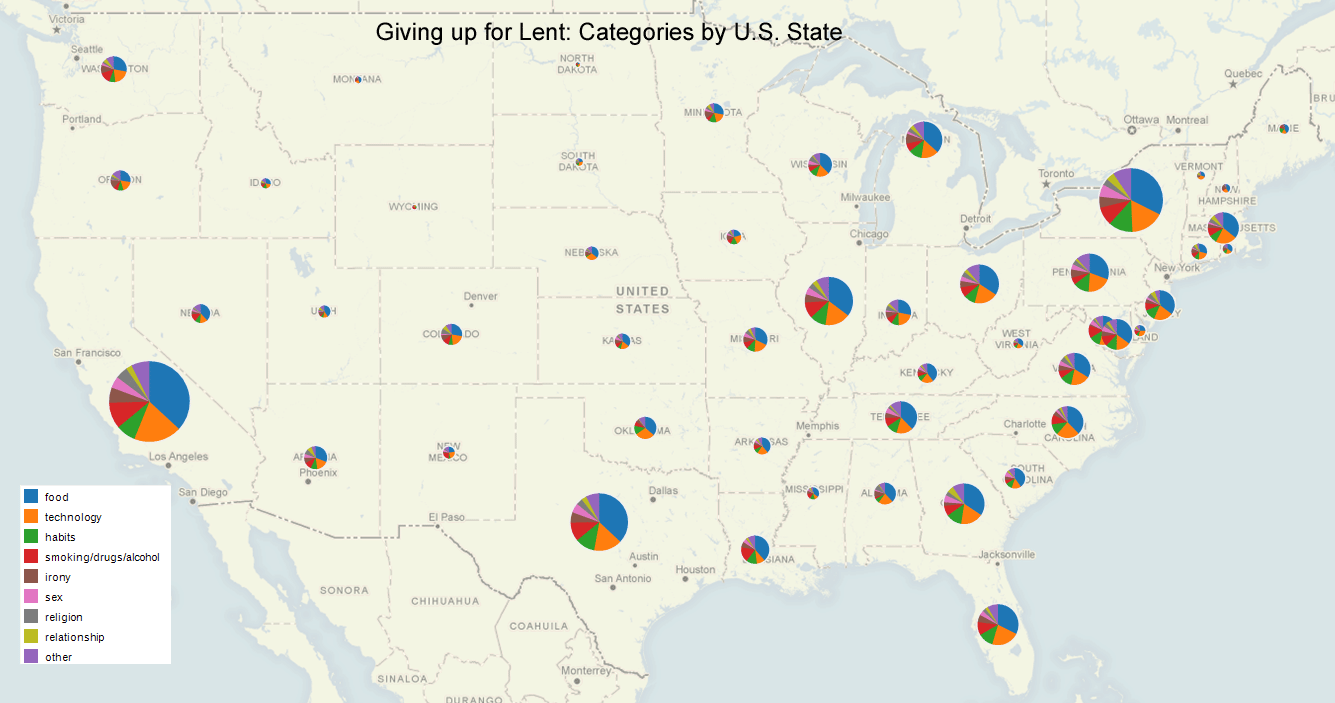 Size indicates the relative number of Twitterers in each state giving up something for Lent. Sorry, Alaska and Hawaii.
 The composition of each state’s categories of tweets shows mostly minor variations among states. Some states (like Wyoming on the far right) have small numbers of tweets. I would have liked to use opacity or width to indicate this disparity but couldn’t figure out how to do it.
This treemap shows how the data changed between 2009 and 2010. The size of the box shows the number of people giving up each category and thing, while color indicates the percentage change from last year: dark blue indicates the steepest drop; dark orange indicates the steepest rise. The second chart shows the same data more conventionally expressed.


I created these charts mostly to explore how the new data-analysis software Tableau Public works. One of its claims to fame is that you can publish interactive visualizations to the web, a feature I didn’t take advantage of here. Tableau doesn’t do treemaps, so I used Many Eyes to create the treemap; the closest Tableau equivalent appears below the treemap.
Posted in Lent, Twitter, Visualizations
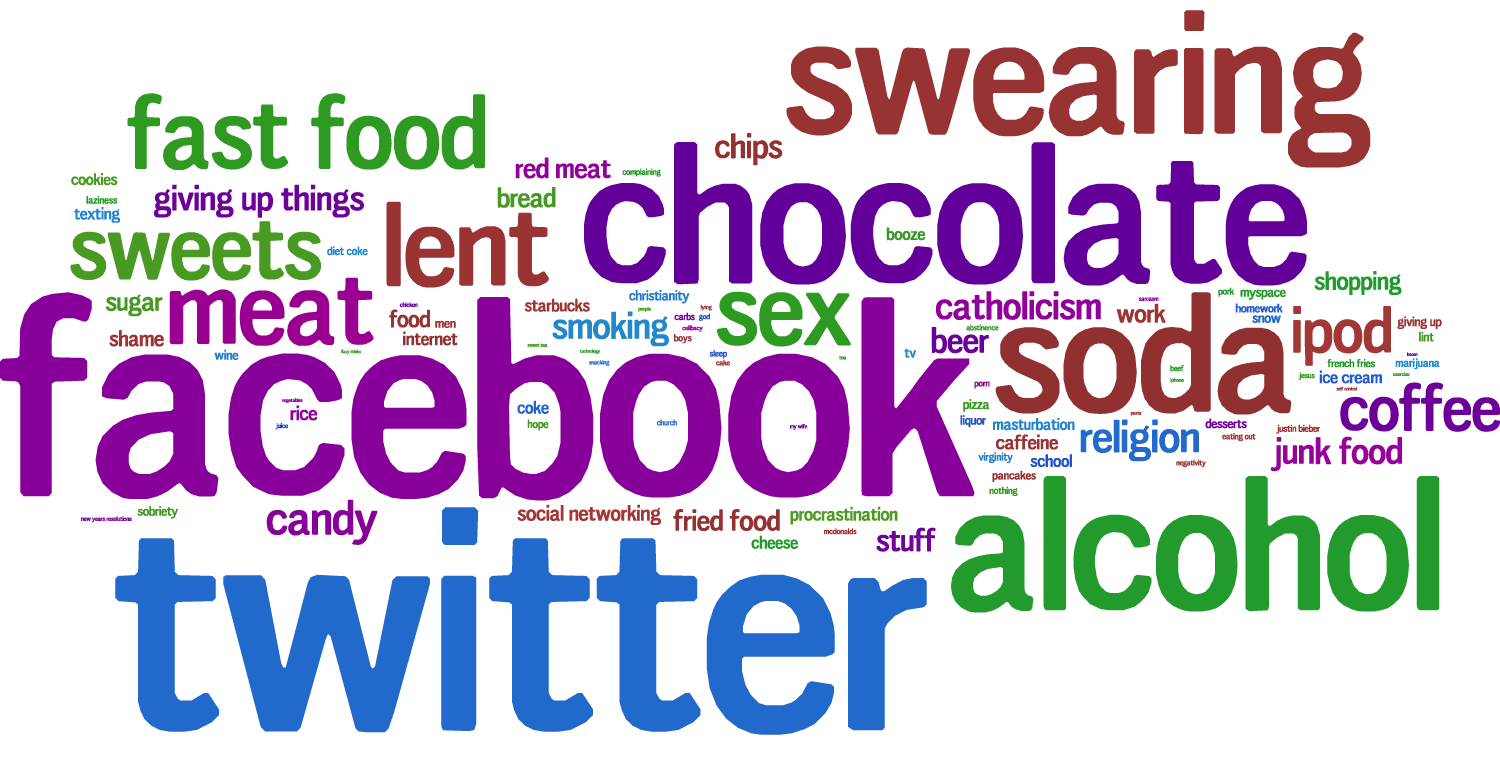
Snow makes the list this year, understandable given the Snowpocalypse and Snowmageddon that gripped much of the Eastern U.S. in the weeks preceding Ash Wednesday. IPods also made the list after the Bishop of Liverpool asked people to consider praying instead of listening to them. This year a celebrity, Justin Bieber, cracks the top 100. He beat out the Jonas Brothers, 64 votes to 11; draw your own conclusions.
The list largely tracks last year’s list. It draws from 40,000 tweets retrieved February 14-20, 2010.
| Rank | Word | Count | Change from last year's rank |
|---|---|---|---|
| 1. | 2089 | +1 | |
| 2. | 1874 | -1 | |
| 3. | Chocolate | 1323 | 0 |
| 4. | Alcohol | 1258 | +1 |
| 5. | Swearing | 1158 | +5 |
| 6. | Soda | 1126 | 0 |
| 7. | Lent | 792 | -3 |
| 8. | Meat | 720 | 0 |
| 9. | Sex | 701 | +7 |
| 10. | Fast food | 695 | +7 |
| 11. | Sweets | 627 | 0 |
| 12. | Coffee | 445 | -5 |
| 13. | iPod | 437 | |
| 14. | Candy | 325 | +18 |
| 15. | Religion | 305 | -6 |
| 16. | Catholicism | 264 | -4 |
| 17. | Smoking | 254 | +5 |
| 18. | Junk food | 251 | +34 |
| 19. | Giving up things | 241 | -6 |
| 20. | Beer | 241 | -5 |
| 21. | Chips | 234 | +24 |
| 22. | You | 233 | +13 |
| 23. | Stuff | 217 | -3 |
| 24. | Fried food | 199 | +33 |
| 25. | Red meat | 193 | +19 |
| 26. | Bread | 187 | +13 |
| 27. | Sugar | 183 | -8 |
| 28. | Work | 176 | -14 |
| 29. | Shopping | 174 | +11 |
| 30. | Food | 162 | -7 |
| 31. | Shame | 150 | |
| 32. | Social networking | 147 | -2 |
| 33. | Caffeine | 136 | -6 |
| 34. | Rice | 136 | +44 |
| 35. | Procrastination | 127 | -11 |
| 36. | Internet | 126 | -11 |
| 37. | Cheese | 120 | +1 |
| 38. | Coke | 120 | +41 |
| 39. | Starbucks | 119 | +14 |
| 40. | School | 118 | +36 |
| 41. | Ice cream | 118 | +13 |
| 42. | Booze | 117 | -21 |
| 43. | Texting | 114 | +28 |
| 44. | Masturbation | 111 | |
| 45. | Cookies | 110 | +11 |
| 46. | TV | 97 | -18 |
| 47. | Christianity | 96 | 0 |
| 48. | Snow | 96 | |
| 49. | Wine | 92 | -13 |
| 50. | Pizza | 91 | +12 |
| 51. | MySpace | 91 | +4 |
| 52. | Men | 90 | +31 |
| 53. | Giving up | 89 | -19 |
| 54. | Sobriety | 89 | -13 |
| 55. | Liquor | 87 | |
| 56. | Desserts | 87 | |
| 57. | Lint | 87 | -20 |
| 58. | Pancakes | 82 | -29 |
| 59. | Homework | 81 | +28 |
| 60. | Marijuana | 80 | |
| 61. | Diet Coke | 80 | -28 |
| 62. | Hope | 78 | +15 |
| 63. | Virginity | 76 | |
| 64. | French fries | 75 | -15 |
| 65. | Laziness | 71 | +5 |
| 66. | Boys | 67 | |
| 67. | Nothing | 67 | -19 |
| 68. | Carbs | 66 | -4 |
| 69. | Justin Bieber | 64 | |
| 70. | Pork | 64 | |
| 71. | Porn | 63 | +9 |
| 72. | Me | 62 | 0 |
| 73. | Sleep | 61 | -42 |
| 74. | Complaining | 58 | -16 |
| 75. | Eating out | 58 | -8 |
| 76. | Jesus | 55 | -26 |
| 77. | McDonald's | 55 | |
| 78. | Beef | 54 | +18 |
| 79. | Church | 54 | +6 |
| 80. | God | 53 | -21 |
| 81. | Abstinence | 53 | -39 |
| 82. | Cake | 52 | |
| 83. | Negativity | 52 | |
| 84. | Him | 49 | |
| 85. | Juice | 47 | |
| 86. | Celibacy | 44 | +13 |
| 87. | Chicken | 42 | |
| 88. | Lying | 42 | |
| 89. | New Year's resolutions | 42 | -29 |
| 90. | Sarcasm | 42 | -39 |
| 91. | Snacking | 41 | |
| 92. | My wife | 39 | |
| 93. | Tea | 37 | |
| 94. | iPhone | 37 | |
| 95. | Exercise | 36 | -6 |
| 96. | Sweet tea | 35 | |
| 97. | People | 35 | |
| 98. | Vegetables | 34 | |
| 99. | Pasta | 33 | |
| 100. | Self control | 33 |
Image created using Wordle.
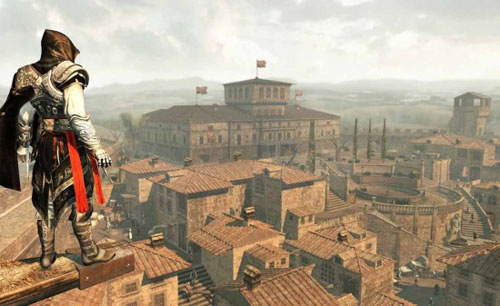
Melik Kaylan writes in today’s Wall Street Journal about how the detailed historical settings in the videogame Assassin’s Creed II allow the player to time-travel to Renaissance Italy (link works now but may not always):
[T]he game is set in Florence, Venice and Rome over a number of decades leading up to the year 1499. The game's producer-authors… labored lovingly to re-create the environs as exactly as possible. They hired Renaissance scholars to advise on period garb, architecture, urban planning, weaponry and the like. They took tens of thousands of photographs of interiors and streets. They used Google Earth liberally to piece together the ground-up and sky-down perspectives through which the action flows…. The hazy colors and the distant sound of river birds are uncannily correct. Nowadays, the tourist hordes can blot out all sense of history. Once you've navigated it on AC2, when you visit the Ponte Vecchio in person the illusion persists of a highly intensified sense of place. In other words, the video brings the place sharply back to life.
Recreating history comes at a price: the budget for the game is something north of $20 million. I hope that the publishers will find a way to put some of their investment to educational use; I for one would love to visit Renaissance Italy without having to assassinate people once I get there.
Someday I hope to see a recreation of ancient Jerusalem this detailed, though I can’t imagine what kind of game could justify the pricetag. In the future, maybe the cost of creating virtual time travel will drop far enough to be within reach of small schools, companies, or individuals.
(Note: I haven’t played the game and don’t intend to. As you might guess from the title, it appears to involve lots of killing. If you’re OK with seeing that kind of thing, on YouTube one of the developers walks through some of the gameplay.)
Posted in Virtual Reality
Search over 1.2 million Bible verses on Twitter–nearly every tweet that has mentioned a Bible verse since April 2009. You can also see a list of the most popular verses on Twitter over the past few hours (“Trending Verses”).
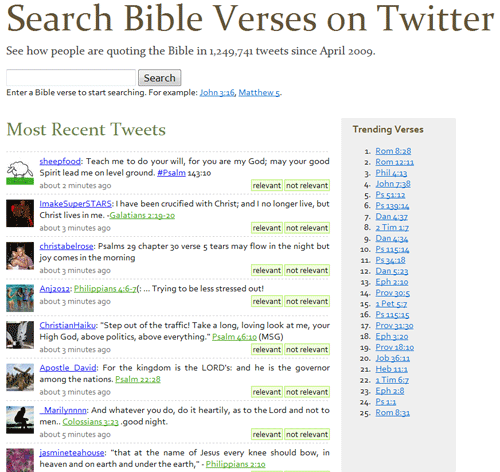
This project uses several APIs from Twitter and is still in a beta stage. It could evolve in several directions, but I want to see how people use it before developing it further.
It’s not quite realtime, but the most recent tweet is rarely more than a few minutes old.
Behind the scenes, it processes tweets to try to ensure their relevance; it has about a 92% accuracy rate based on a training corpus of around 45,000 tweets. Use the “relevant” and “not relevant” buttons in the interface if you see a tweet that you think should or shouldn’t belong. (I’m mostly interested in the latter, but it seems weird not to have both–like Facebook’s lack of an unlike button.)
It currently uses Logos RefTagger to link the Bible references in the tweets.
Feel free to leave a comment here if you have a feature idea or want to make any suggestions.
Edit February 2016: This feature is no longer available; with over 200 million tweets, it’s just too much data to serve reliably. Instead, the latest tweets are visible.
Posted in Twitter
When people tweet about Bible verses on Twitter, what words do they use? Here are the top 100:
Extracting Bible references from text means identifying whether a given piece of text is referring to a Bible verse or something else. For example, the meaning of Acts 2 depends on context:
When you encounter a phrase that could be a Bible reference, you have to look at context to determine whether the phrase is a Bible reference. Humans can make this leap pretty easily, but computers need rigorous models and lots of training data to guess whether an ambiguous phrase is a Bible reference. In the above example, the phrase “early church” is a strong indicator that the phrase “Acts 2” is a Bible reference, while the phrase “years old” is an indicator the other way.
Twitter, with its high volume of content and decent search engine, provides lots of training data.
Using the Twitter Search API, I downloaded 30,000 tweets possibly containing Bible references (e.g., [john 3], [jeremiah 29]) and then categorized them by hand as referring to a Bible verse or not.
I then ran a Naive Bayes algorithm on the resulting tweets to produce the above list, which contains the words that most strongly indicate the presence of a Bible reference.
This list suffers from sample bias, of course: a different set of tweets would produce a different list. In addition, the list is Twitter-centric; the results may not carry over into blogs or other media. (People substitute the number “2” for the word “to” and “4” for “for” on Twitter more frequently than they do elsewhere, for example, which oversamples content like “I’m meeting Matthew 4 dinner.”)
Search for Bible references on Twitter. Use the relevant and not relevant buttons to improve the filtering. I haven’t formally announced this new feature of OpenBible.info yet; consider the link a preview.
Posted in Collective Intelligence, Twitter
The new Bible Translation Personas experiment uses Aaron Zinman’s Personas project to scrape the web for mentions of Bible translations and then assigns a list of categories to each one, ultimately resulting in a colored strip that supposedly provides insight into the translation. As other commenters have noted, the animation process is more interesting than the result. In the case of Bibles, I’m not sure the result reveals much of interest.

Posted in Labs
Unless otherwise indicated, all content is licensed under a Creative Commons Attribution License. All Scripture quotations, unless otherwise indicated, are taken from The Holy Bible, English Standard Version. Copyright ©2001 by Crossway Bibles, a publishing ministry of Good News Publishers. Contact me: openbibleinfo (at) gmail.com.
