Blog

Venn Diagram of Google Bible Searches

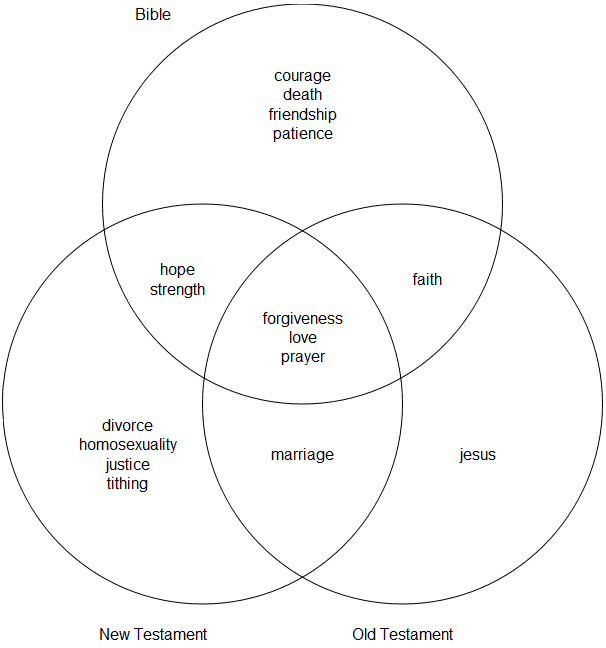
Technomancy.org just released a Google Suggest Venn Diagram Generator, where you enter a phrase and three ways to finish it: for example, “(Bible, New Testament, Old Testament) verses on….” It then creates a Venn diagram showing you how Google autocompletes the phrase and where the suggestions overlap.

The below diagram shows the result for “(Bible, New Testament, Old Testament) verses on….” The overlapping words–faith, hope, love, forgiveness, prayer–present a decent (though incomplete) summary of Christianity.

A Venn diagram shows completions for (X Verses on...): Bible (courage, death, friendship, patience), New Testament (divorce, homosexuality, justice, tithing), Old Testament (Jesus), NT + Bible (hope, strength), OT + Bible (faith), OT + NT (marriage), and all three (forgiveness, love, prayer).

Posted in Collective Intelligence, Topics, Visualizations

Procedurally Generating Archaeological Sites

Walking around an archaeological site–whether an active dig or excavated ruins–makes you wonder what it would be like to see the site in its glory days. Existing computer tools make it possible to model small-scale sites virtually (a building, perhaps), but anything larger than a city block would take a long time to create. Even a small city is beyond the capabilities of any but the most dedicated team.

One solution is procedural generation, where a human designer lays down a few rules–a basic city plan, for example–and a computer fills in the rest according to those rules. The result is a complete rendering of a city filled with buildings that plausibly inhabit the space, with a human only having to set up the initial parameters. Consider this reconstruction of Pompeii:

The creators of this video started with street plans and a variety of historically correct architectural models. A computer then generated buildings that fit the excavated ruins, resulting in a city that you can tour virtually. While it undoubtedly has inaccuracies, the result is compelling.

Pompeii is better-preserved than most ancient cities, but you can apply a similar technique to any archaeological site. Archaeologists have partially excavated many biblical cities; they know at least some of the city’s layout. Even if they don’t know the whole thing, they can guess at what features a city of a given size needs; by starting with what archaeologists know, a computer can extrapolate a plausible street plan for the rest of the city. (I suppose that you could run the simulation many times and generate a probability of where a certain building–such as a synagogue–is likely to be.)

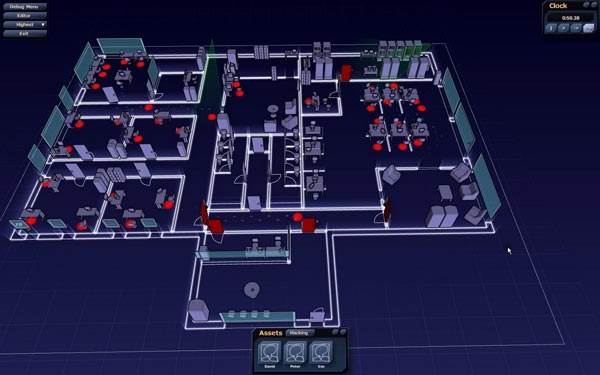
These projects don’t often generate interior spaces or simulate objects like furniture, both of which dramatically increase the complexity of the simulation for only a modest benefit. But there’s no reason why we couldn’t model interior spaces. A forthcoming game called Subversion, for example, uses procedural generation on both macro and micro scales: it generates both complete cityscapes and architectural floorplans of the buildings that it creates.

A screenshot from Subversion shows a building's procedurally generated floorplan.

Recreating interiors for ancient houses is fairly straightforward: floorplans weren’t nearly as complicated as they are today. Imagine walking around ancient Capernaum, for example, and visiting the house where people lowered a paralytic through the roof. Architecture plays a crucial role in the story, a role that a virtual-reality model would help illuminate.

Further Reading

  1. Procedural, Inc. creates software for procedurally generating cities, both modern and ancient.
  2. Rome Reborn from the University of Virginia recreates ancient Rome using a combination of hand-modeled buildings (for thirty models and 250 elements) and procedurally generated buildings (for the remaining 6,750 buildings). Academic papers provide more technical detail, especially the one by Dylla, Kimberly, Frischer, et al. (PDF). They use the Procedural, Inc. software.
  3. A Subversion video shows the steps a computer goes through to generate a cityscape.
  4. Procedural 3D Reconstruction of Puuc Buildings in Xkipché demonstrates an academic application of the technology applied to archaeology.
  5. Magnasanti talks about the "ultimate" SimCity city and was the inspiration for this post.

Posted in Virtual Reality

Bible Geography in Tableau

Robert Rouse combines Bible geo data with Tableau to produce an interactive map that uses size to emphasize important places and allows you to filter the data by book:

Bible Places
(As of August 2026, this visualization no longer works.)

He ’s also written a blog post that goes into detail about the map. The blog is about technology and the Bible, so take a look at his other posts if those topics interest you.

Posted in Geo

Visualizing Pericope Similarity in the New Testament

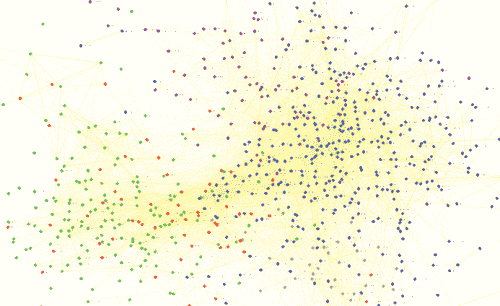
This diagram plots the similarity of pericopes (sections) in the New Testament based on their linguistic similarity in Greek:

Blue = Gospels, Purple = Acts, Green = Paul’s Epistles, Red = General Epistles, Gray = Revelation

If you don’t have Silverlight installed (or are reading this post via RSS–I suggest you click through to the original post), here’s a thumbnail:

Pericope similarity in the New Testament (thumbnail).

Download the full-size PDF (300KB) or PNG (22 MB, 12,000 pixels wide).

Do we actually learn anything from this kind of diagram? The most interesting part to me is how the gospels on the right flow primarily through the Gospel of John to the epistles on the left. I wonder why that is.

Methodology

I calculated the cosine similarity between the full text of the pericopes using the Greek lemmas (after removing about forty stopwords). The pericope titles come from the ESV. I produced the diagram with Cytoscape. The widget at the top of the post comes from zoom.it, Microsoft’s Deep-Zoom-as-a-Service.

Bill Mounce’s excellent free New Testament Greek dictionary served as the source of the lemmas.

Posted in Linguistics, Visualizations

Apologetics and Anti-Apologetics Apps

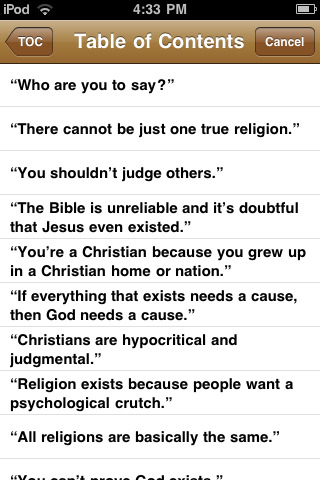
The New York Times discusses the latest iPhone trend: apps that provide talking points for the existence of God, pro and con.

In a dozen new phone applications, whether faith-based or faith-bashing, the prospective debater is given a primer on the basic rules of engagement — how to parry the circular argument, the false dichotomy, the ad hominem attack, the straw man — and then coached on all the likely flashpoints of contention....

Users can scroll from topic to topic to prepare themselves or, in the heat of a dispute, search for the point at hand — and the perfect retort.

I expect that, eventually, we’ll just let our phones argue the basic questions of existence among themselves, and then they’ll let us know what they’ve decided.

A screenshot from the LifeWay Fast Facts app

Posted in Technology

Automatically Deciphering Ugaritic

Let’s say you have text in front of you written in a language you don’t read–worse, no one has understood the language for thousands of years. How can you begin to understand it? MIT researchers have created a way to for a computer to decipher Ugaritic in a few hours without knowing anything about the language besides its general similarity to Hebrew.

One of the researchers says:

The decipherment of Ugaritic [in the mid-twentieth century] took years and relied on some happy coincidences — such as the discovery of an axe that had the word “axe” written on it in Ugaritic. “The output of our system would have made the process orders of magnitude shorter.”

I love that someone felt the need to write “axe” on an axe. Maybe it was the original brand name.

I’m most curious whether the program can help crack the Minoan language on Linear A.

Incidentally, the article What’s Ugaritic Got to Do with Anything? explains why Ugaritic is important to understanding the Hebrew of the Old Testament.

Via.

Posted in Linguistics

Church Names in the U.S.

If you were to name a church, how would you go about it? Let’s see how people have named churches in the U.S. by looking at a random sample of 300,000 church names gathered using the Yahoo! Local Search API.

The Word "Church"

You might start with the word “church” in your name. About 2/3 of churches in the dataset have the word “church.” (The number of churches with the word “church” in reality is higher, as the dataset often truncates names.) Other popular nouns: center, fellowship, chapel, assembly, ministries (or ministry), temple, tabernacle, and iglesia.

Most Common Words in Church Names

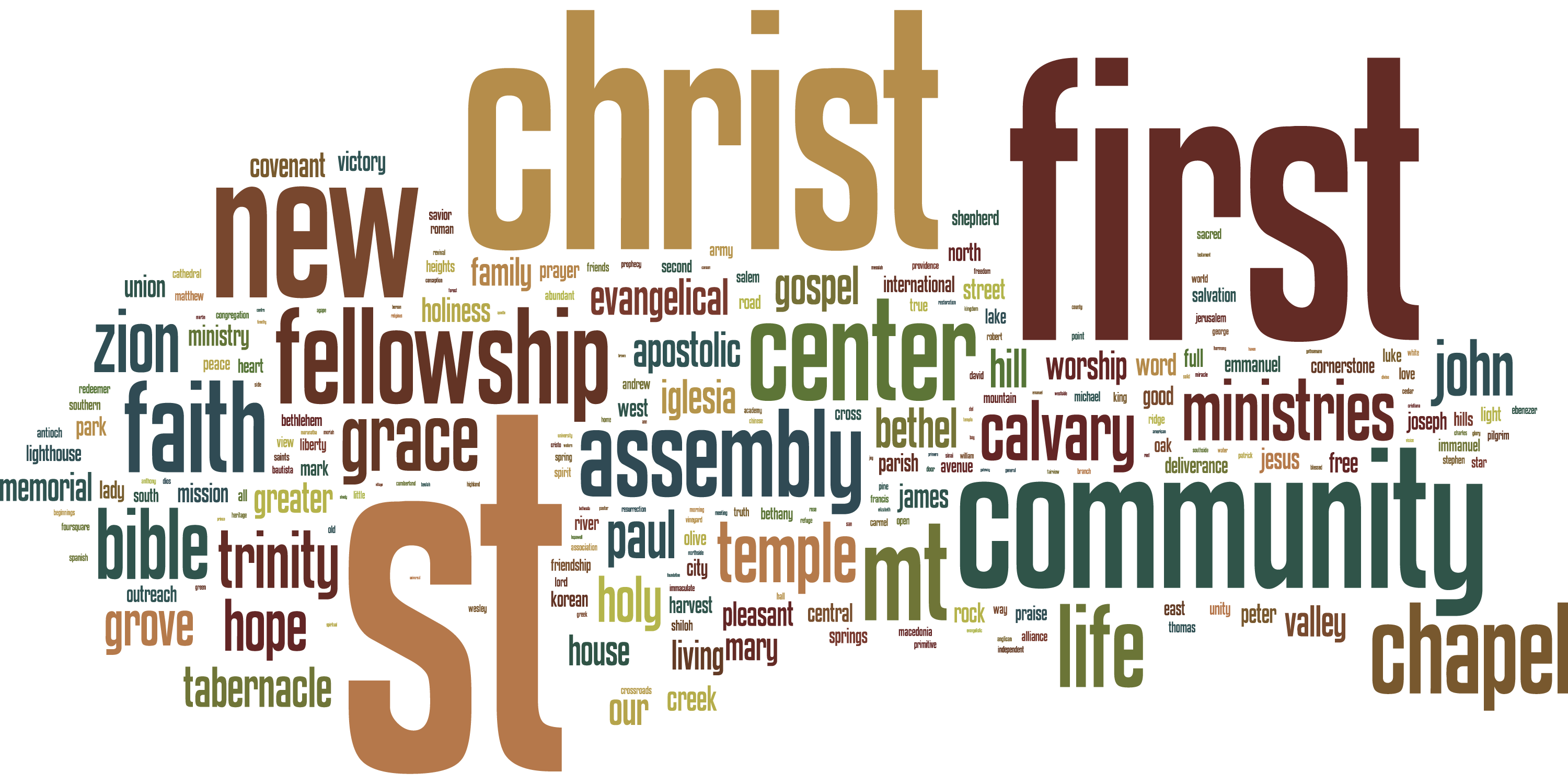
Here’s a wordle of the most common words that appear in church names (excluding the word “church”):

Wordle of the most-common words in church names.

Most Common Words in Church Names, Excluding Denominations

Denominations overpower the raw list. Here’s a wordle of the same data without denomination names:

Wordle of the most-common words in church names, excluding denominations.

Full Church Names

Here are the most common church names in the U.S. Also download the top 1,000 church names in the U.S. (29 KB Excel document), covering 95,000 churches, if you want more information.

Church NameChurches
first baptist church5,115
church of christ2,854
first united methodist church2,149
first presbyterian church1,960
united methodist church1,488
seventh-day adventist church1,478
first christian church1,309
calvary baptist church1,197
church of the nazarene915
trinity lutheran church892
salvation army867
first assembly of god744
church of god677
faith baptist church663
st john's lutheran church601
grace baptist church600
first congregational church575
assembly of god church565
new hope baptist church540
zion lutheran church523

Saints

The word “St.” (Saint) is common in more traditional churches, such as Catholic, Episcopalian, and Lutheran. Here are the most popular saint names used for churches:

SaintChurches
John3,713
Paul3,210
Mary1,832
Peter1,362
James1,270
Joseph1,153
Mark1,062
Luke1,053
Andrew789
Matthew724
Stephen582
Michael532
Francis530
Thomas511
Patrick431
Anthony381
George329
Ann(e)282
Nicholas253
Elizabeth220

Mountains

Mountains and hills are common names for churches. I suspect that “Spring Hill” and the assorted “Pleasant"s come from the city names where the churches stand.

MountainChurches
mt zion1,587
mt olive(t)1,122
mt calvary619
mt carmel528
mt pleasant475
pleasant hill394
mt moriah329
mt sinai316
zion hill200
mt pisgah191
mt nebo139
mt tabor136
mt pilgrim112
mt hope108
mt gilead95
mt bethel90
spring hill90
mt hermon85
mt lebanon74
mars hill59

Denominations

Here are the most-common two-word phrases (including denomination names) used in some of the more popular denominations. “First” appears in 12% of Baptist church names, 10% of Methodist church names, only 3% of Lutheran church names, and fully 21% of Presbyterian church names.

BaptistMethodistLutheranPresbyterian
first baptistunited methodisttrinity lutheranfirst presbyterian
missionary baptistfirst unitedst john'sunited presbyterian
freewill baptistchapel unitedst paul'scumberland presbyterian
grove baptistfree methodistevangelical lutherankorean presbyterian
calvary baptisttrinity unitedzion lutheranwestminster presbyterian
hill baptistmemorial unitedgrace lutherancovenant presbyterian
zion baptistst paulour savior'scommunity presbyterian
hope baptistgrace unitedfaith lutheranmemorial presbyterian
creek baptistgrove unitedimmanuel lutherantrinity presbyterian
faith baptistwesley unitedchrist lutheranorthodox presbyterian
mt zionzion unitedpeace lutheranreformed presbyterian
bethel baptisthill unitedredeemer lutherangrace presbyterian
new hopechrist unitedfirst lutheranhill presbyterian
grace baptistbethel unitedgood shepherdfaith presbyterian
bible baptistfaith unitedhope lutheranhope presbyterian
chapel baptisthope unitedcalvary lutheranchrist presbyterian
community baptiststreet unitedbethlehem lutherancentral presbyterian
mt oliveasbury unitedst peter'svalley presbyterian
memorial baptistpark unitedbethany lutherancreek presbyterian
southern baptistsalem unitedmessiah lutheranpark presbyterian

Posted in Churches

Bible Cross References Visualization

Here’s a visualization of 340,000 Bible cross references:

Visualization of Bible cross references. Larger version (2,000 x 1,600 pixels).

Does anything strike you as intriguing? A few trends jump out at me:

  1. The frequency of dense New Testament streaks in the Old Testament, especially in Leviticus and Deuteronomy; I didn't expect to see them there.
  2. The loops in Samuel / Kings / Chronicles and in the Gospels indicating parallel stories.
  3. The sudden increased density of New Testament references in Psalms through Isaiah.
  4. The eschatological references in Isaiah and Daniel.
  5. The density of references from the Minor Prophets back to both the Major Prophets and earlier in the Old Testament.
  6. The surprising density of cross references in Hebrew-Jude.
  7. The asymmetry. If verse A cites verse B, verse B doesn't necessarily cite verse A. I wonder if I should make the data symmetrical.

You can also download the full-size image (10,000 x 8,000 pixels, 75 MB PNG). It’s a very large image that could crash your browser. If you want it, I strongly recommend that you save it to your computer rather than trying to open it in your browser.

This visualization uses data from the Bible Cross References project. I used PHP’s GD library to create the graphic.

Inspired by Chris Harrison and Christian Swinehart’s wonderful Choose Your Own Adventure work.

Posted in Cross References, Visualizations

New in Labs: Cross References

Browse 340,000 Bible cross references. Make the list better by voting on relevant or irrelevant verses.

For example, try Philippians 4:13 (“I can do all things through Christ who strengthens me”) or Isaiah 40:31 (“They shall mount up on wings like eagles”).

Philippians 4:13 cross references

The interface is about as bare-bones as it gets: there’s a list of cross references for a single Bible verse, sorted by relevance (i.e., votes). You can browse to related verses, vote on whether each cross reference is relevant, and see (on external sites) the verses in different translations. It also prints nicely. There’s no way to suggest new cross references, though I may add that feature if there’s demand.

The data comes primarily from The Treasury of Scripture Knowledge (TSK) but blends other data, including the Topical Bible and Twitter Bible Search. All the copies of TSK on the web seem to descend from one source; I did some basic cleaning of the data and extracted the references. Then I blended the other data to weight some cross references more highly than others—that’s where the initial vote counts come from. (Incidentally, I only count around 380,000 cross references in TSK, lower than the usual count of 500,000 cross references you find when people talk about TSK. The lower number of cross references on this site–340,000–comes mostly from removing duplicates and combining adjacent verses.)

The 340,000 cross references in this data are a substantial number–most cross reference systems in print Bibles contain 50,000-100,000 cross references. While this list is more comprehensive, the tradeoff is that some of the cross references are less relevant than you find in print Bibles. As people use this site, however, the most-relevant verses should rise to the top.

The main limitation to the data is that the cross references always point from a single verse rather than from a range of verses: in other words, from Matthew 5:3 instead of from Matthew 5:3-11. Broader cross references—references that apply to a complete passage—are therefore missing from the data, limiting its usefulness somewhat.

The lack of an open, high-quality source of Bible cross references on the web has always bewildered me. This project is an attempt to remedy that deficiency. Feel free to download the raw cross-reference data (2 MB .zip, updated regularly with the latest vote counts) and use it in your projects.

Update April 12, 2010: Fred Sanders at Scriptorium Daily has a great introduction to the Treasury of Scripture Knowledge if you want more background on this work.

Posted in Cross References